A Life-Sized Dual-Arm Robot Brachiates Across Monkey Bars
Most learned locomotion still wants a floor. Ayumu Iwata, Kento Kawaharazuka, and colleagues at the University of Tokyo trained a life-sized dual-arm robot to swing from bar to bar instead.
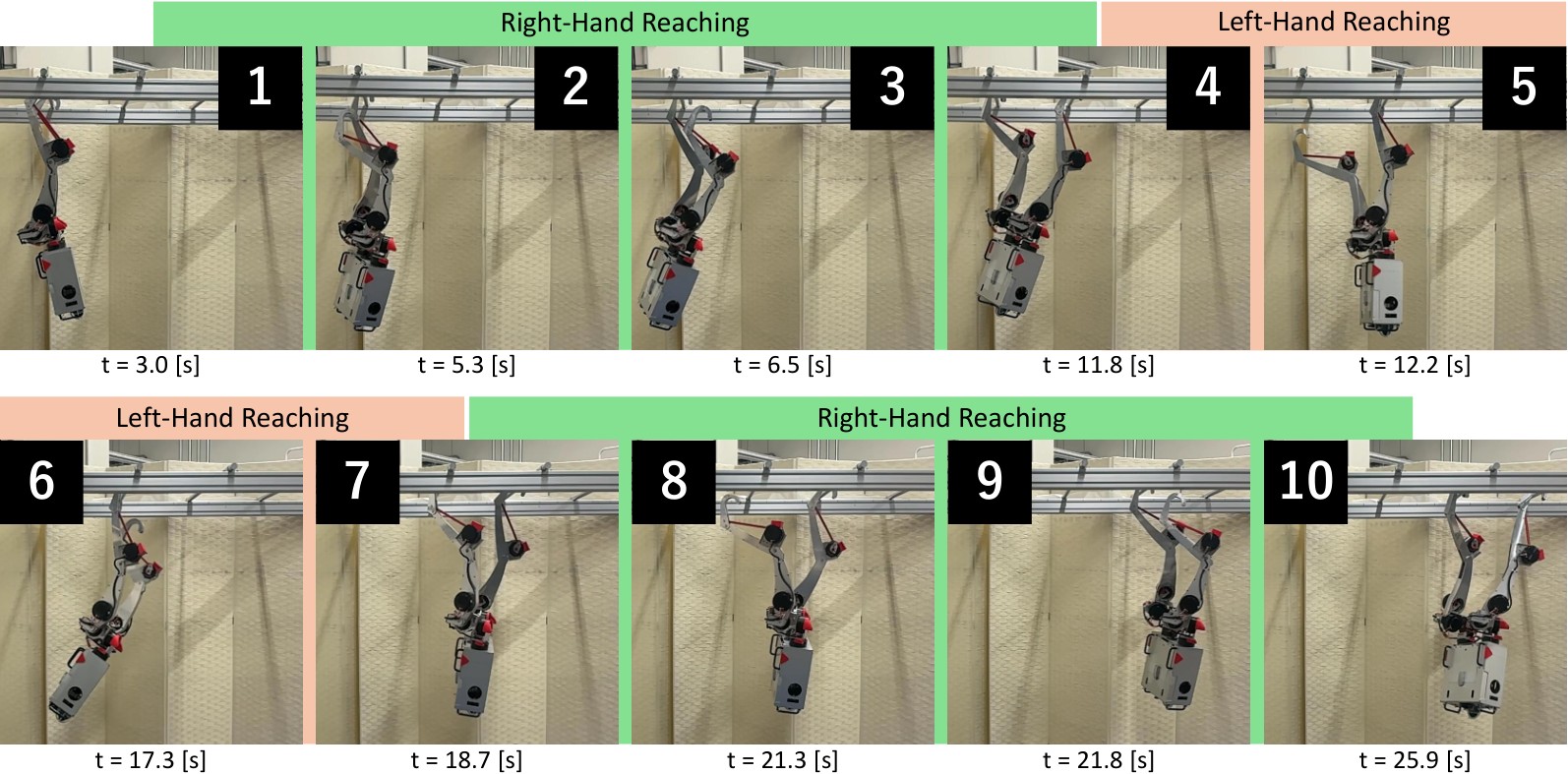
The paper, accepted to IROS 2026, uses Waypoint-Guided Reinforcement Learning (WGRL) because they did not have imitation data that matched hook-shaped hands. On hardware, the robot completes three reaching phases across four 30 mm bars spaced 400 mm apart. The first hook often misses. Recovery shows up anyway, and the course finishes without a fall.
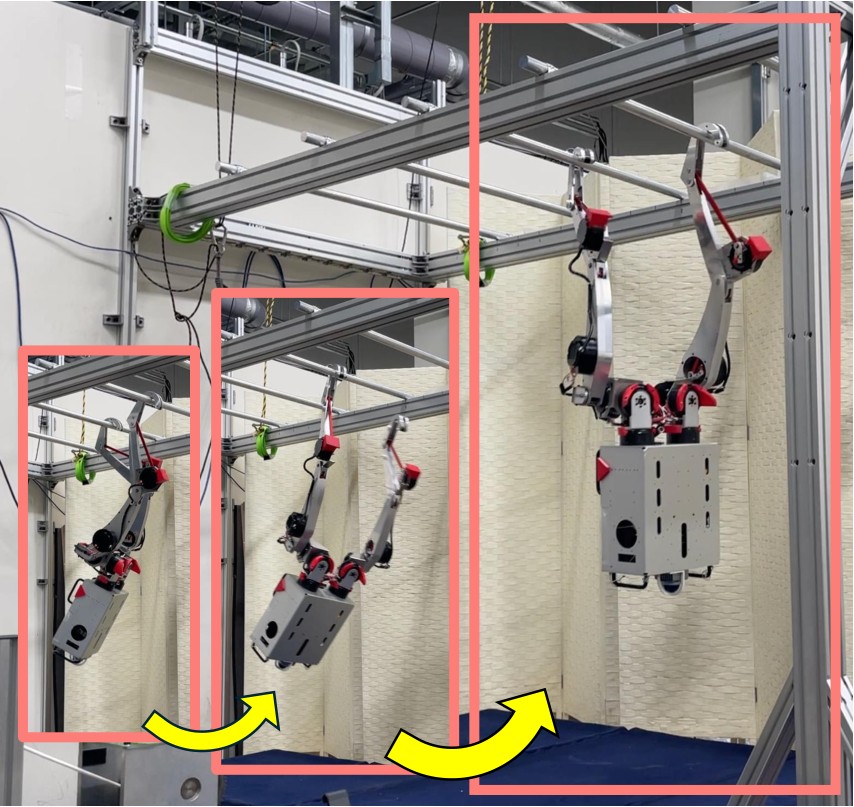
Hardware that can hang
The robot is based on open-source MEVITA hardware. It models an adult upper body: 1,093 mm tall, 19.6 kg, five degrees of freedom per arm (shoulder roll/pitch/yaw, elbow pitch, wrist pitch). Metal limbs, hook end-effectors. The hook arc is 60 mm across a 30 mm bar, with a 180° central angle so it does not dump the robot on a graze.
Training runs in Legged Gym with 4,096 parallel environments. The actor sees IMU, gravity, joints, and a left/right phase bit. The critic gets privileged bar geometry, contacts, and histories. Policy at 50 Hz, PD at 200 Hz.
Five sagittal waypoints teach the reaching hand to unhook backward, pass under the support bar, then wrap the next bar from above. Early training holds a tight distance threshold, then relaxes it. A bar-count success reward and a mechanical-energy term (target −72 J, the dual-hang energy) push the robot to go forward without winding up into a wild pendulum.
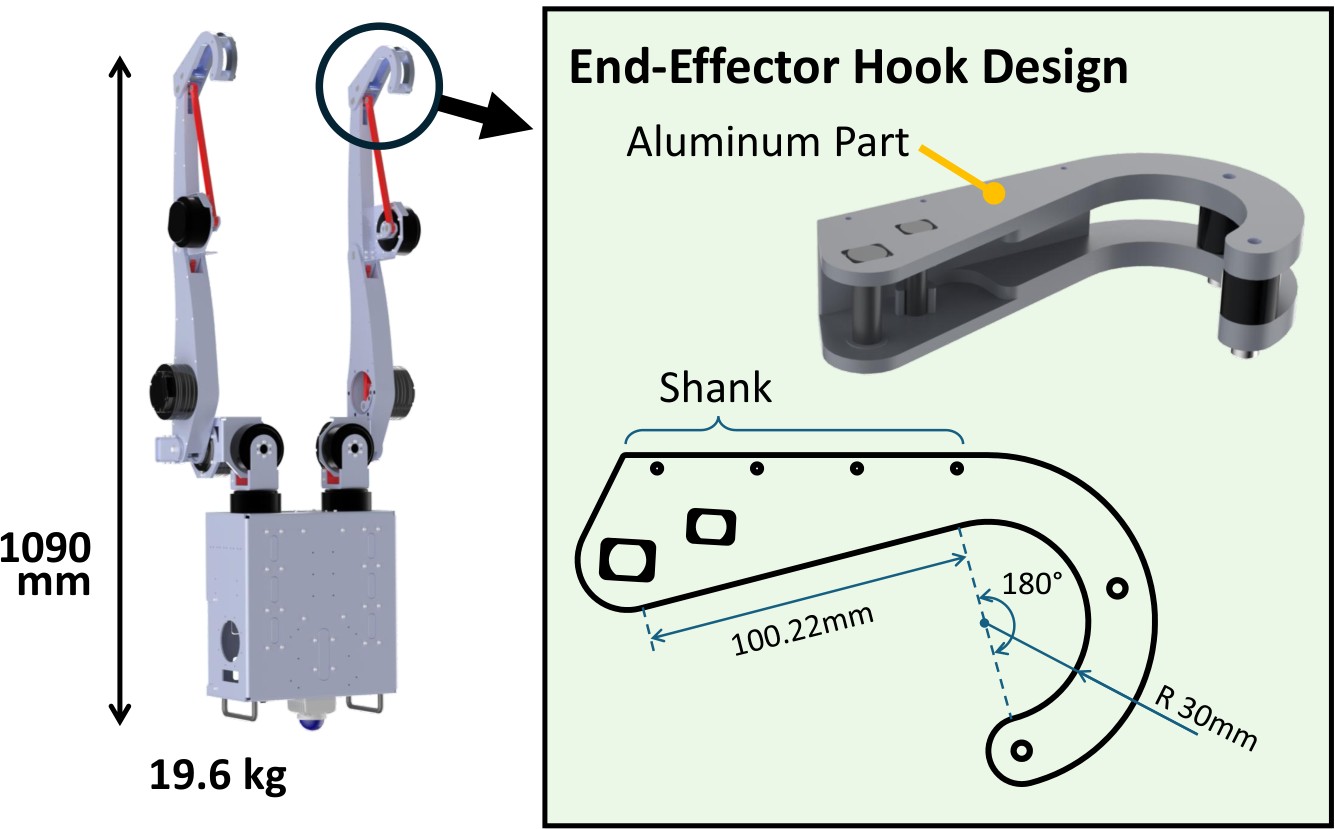
Sim, then the real bars
In MuJoCo, ten trials on even 400 mm spacing all clear more than 30 bars. With bar jitter (±20 mm spacing, ±40 mm vertical, ±0.2 rad yaw), it keeps going and retries after misses. On a 5° incline: 28/30 reaches (93.3%). On a 36-bar circle: 91/100. The actor never sees explicit bar positions.
Hardware is zero-shot. Logs show kinetic energy climbing while it retries on one hook, then decaying toward the energy target once both hands catch. Left-arm swings are shorter period and larger amplitude than the right; the authors say right-hand motion converged first in training and they did not add a symmetry constraint.
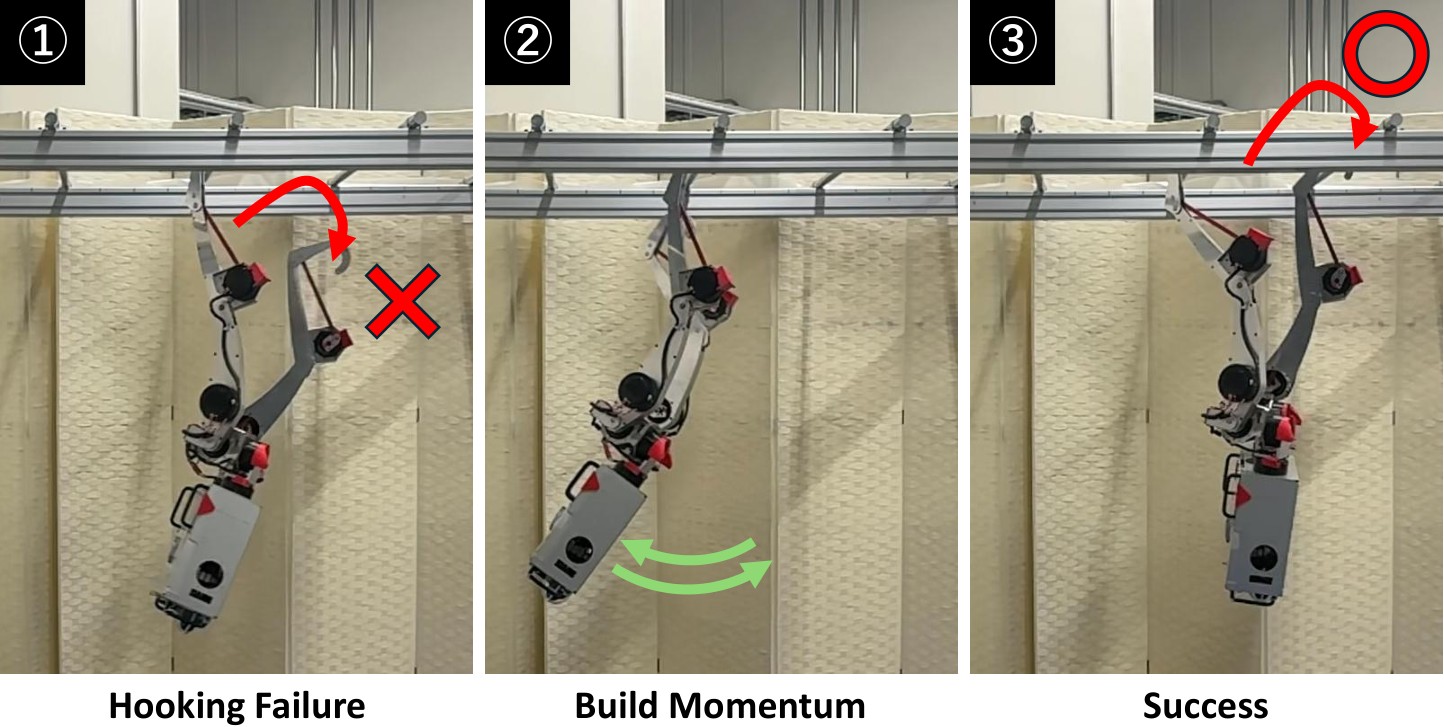
They credit two things for robustness: the hook clearance, and the wrap-from-above trajectory that WGRL induced before the curriculum let go.
A Human’s Take
Monkey bars are a mean test. No feet, discontinuous contacts, and a fall ends the episode. Getting a 20 kg upper body to miss, re-swing, and still finish is the result I care about.
It is still a hook, not a hand, and the bars are in a lab gantry. I would not send this at a jungle gym full of kids. I would send it at any robot team that thinks “locomotion” only means walking.