WHIRL Learns What a Human Would Avoid on a LEAP Hand
Human-in-the-loop RL usually treats a takeover as a one-off save. WHIRL, a CoRL 2026 paper from HKUST (Guangzhou), the Italian Institute of Technology, and Zhejiang University, trains a fourth world-model head to predict the next pedal press, then uses that probability to steer the actor away from those states.
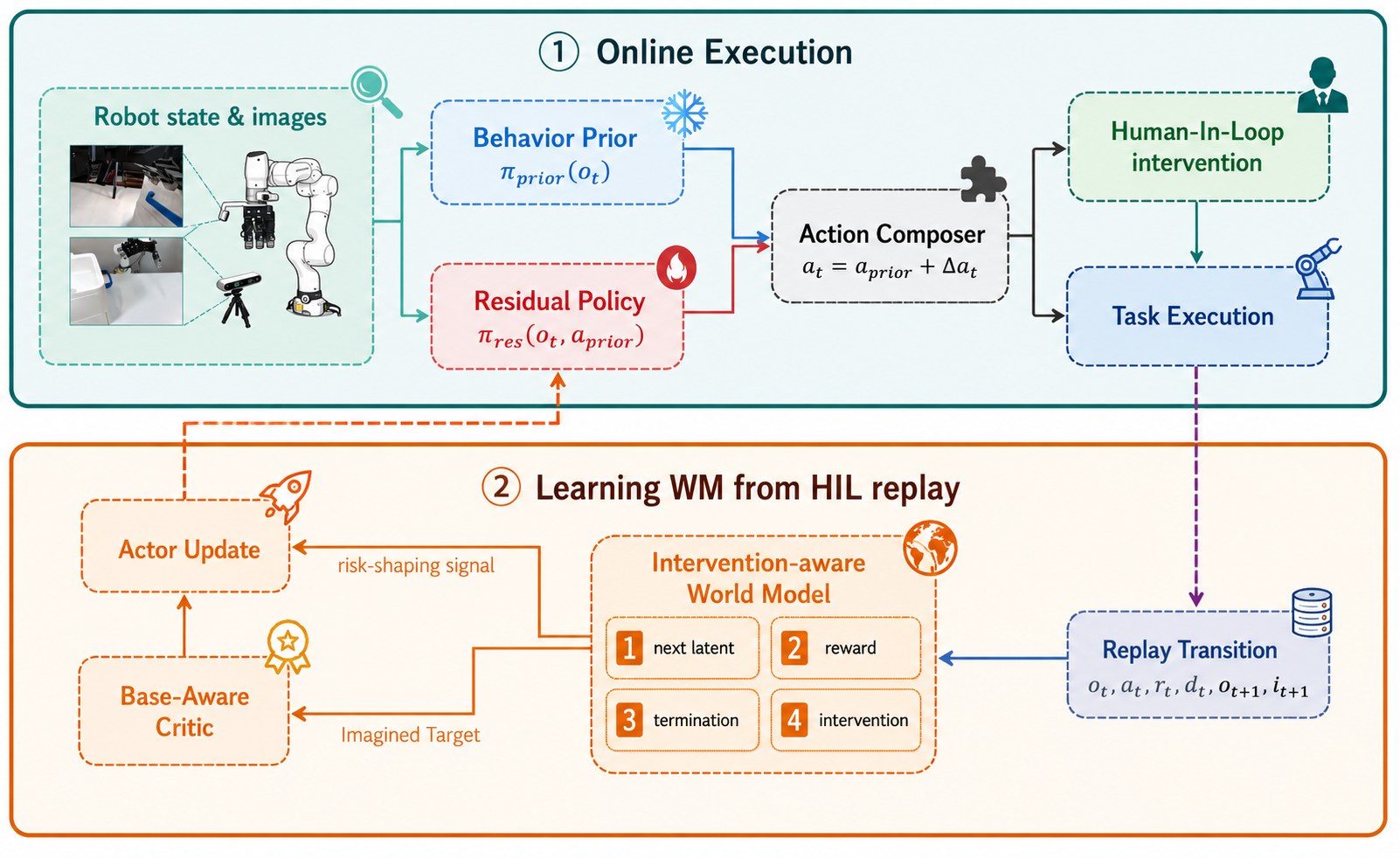
Hardware is a Franka FR3 plus a 16-DoF LEAP Hand, a SpaceMouse, a Manus Quantum glove, and a foot pedal. The residual policy only corrects a frozen behavior-cloning prior. Hand residuals live in a low-dimensional synergy basis, not raw 16-D joint noise.
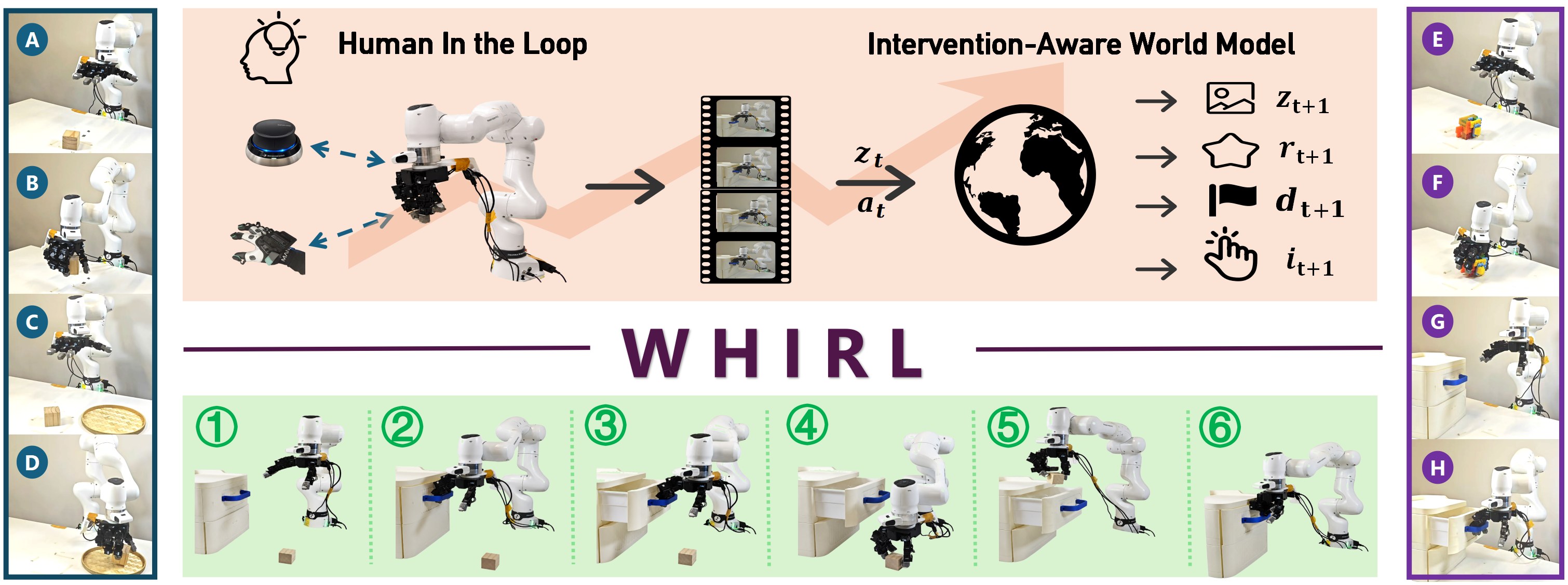
Four heads, one of them is the human
The latent world model predicts dynamics, reward, termination, and next-step intervention probability. Dynamics/reward/termination train the critic. The intervention head is actor-side only. The authors refuse to dump operator habits into the Bellman target.
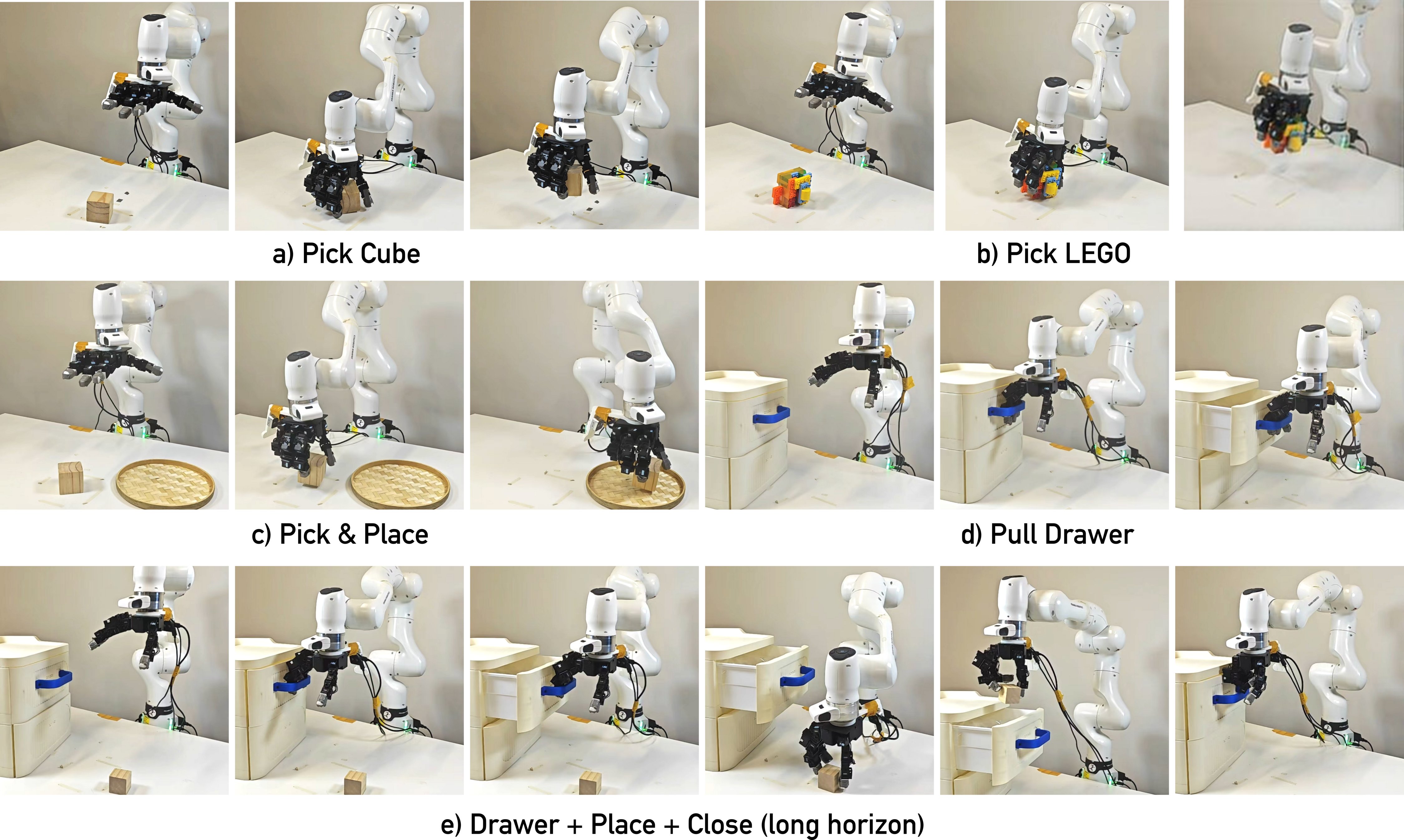
Five real tasks, in-region pose randomization, one seed and one operator per cell (they say seed averaging is too expensive on this hardware):
- Pick Cube
- Pick LEGO
- Pick & Place
- Pull Drawer
- Pull Drawer + Place + Close (long horizon)
The ladder is behavior prior → ResFiT → residual RL (model-free HIL) → WHIRL. WHIRL beats the strongest residual-RL baseline by 15–30 percentage points on every task. Fisher’s exact is p < 0.05 on the three pick tasks; drawer and long-horizon sit around p ≈ 0.08. The abstract’s headline grasp number is 96.7% success on complex grasping.
Operator burden is the other axis. On Pull Drawer, the final rolling 5-episode step-weighted intervention fraction falls from 0.113 to 0.018, an 84% drop. Ablating actor-side intervention shaping (α_i = 0) or removing the world model delays that near-zero regime.
Limits: in-region only, one operator’s takeover threshold, no new objects. Recalibrate if the next human is more jumpy.
A Human’s Take
Using the pedal as a forecast, not a replay mask, is the idea I wish more HIL stacks stole. 84% fewer operator steps on a drawer pull is the kind of number that decides whether a grad student still has a wrist by Friday. One seed and one cautious operator is also the caveat. If the risk head just memorizes that person’s flinch, you have a clone of their anxiety, not a safety model.