WholeBodyWAM Puts a Tabletop World Model on G1’s Legs
World-action models already know how to push a mug around a table. Getting that prior onto a walking humanoid is messier: the legs, waist, and whole-body controller all speak different command languages. Zhuo Li, Yiming Yao, Jim Tan, Mengjie Jing, Zhipeng Dong, and Fei Chen posted WholeBodyWAM on 15 September as a way to keep the tabletop brain and teach it when the body has to help.
The real-robot tests run on a Unitree G1 with two BrainCo Revo 2 hands, a head camera, and two wrist RealSense D435i units.
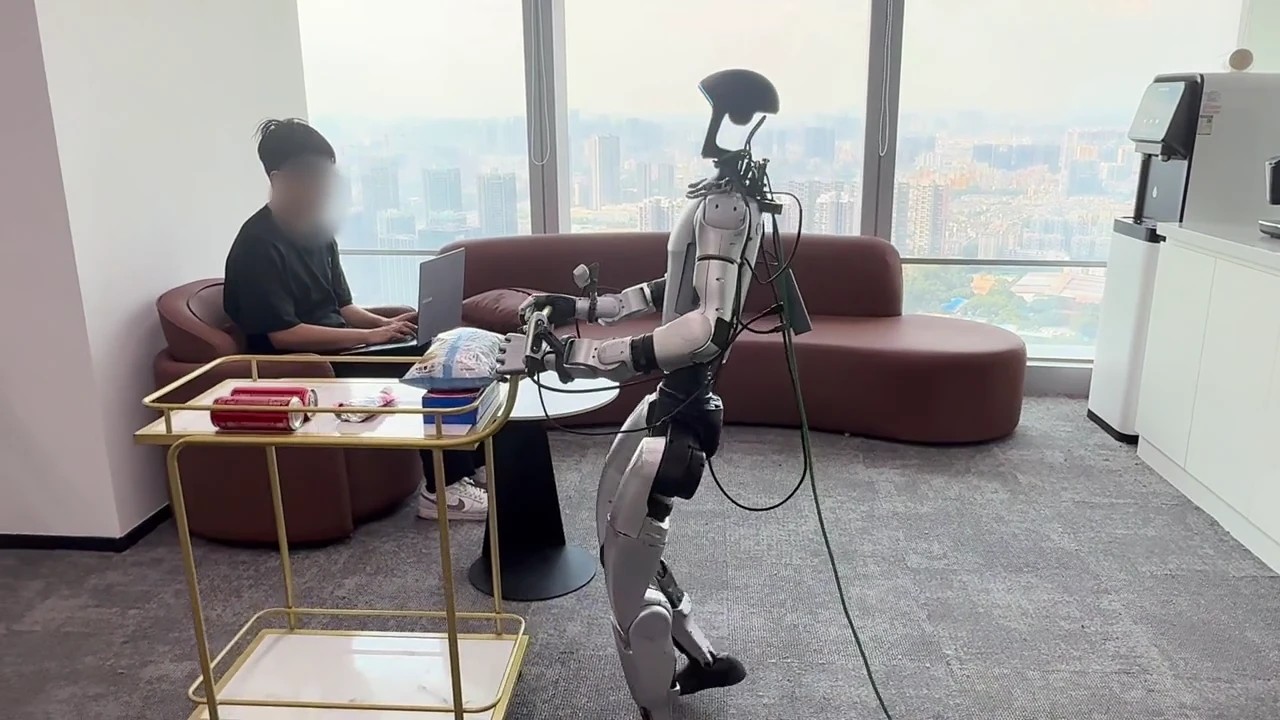
Keep the hands, add a whole-body stream
The model starts from a pre-trained 14B world-action backbone. A shared diffusion transformer jointly predicts future video, arm-and-finger actions, and a 56-dimensional Unified Whole-Body Controller vector: 46 shared slots for base velocity, heading, pelvis height, torso orientation, and lower-body joints, plus 10 residual slots for controller-specific flags.
CASA (coordination-aware self-attention) watches task-directional arm manipulability. When either arm’s capability along the task direction drops, a gate strengthens attention from the manipulation stream into the whole-body stream so the pelvis and steps can make up the difference.
The team collected 15,000 loco-manipulation demonstrations in the SIMPLE simulator with a PICO 4 Ultra headset, retargeted them to G1 with GMR, and post-trained with LoRA (rank 4) for 50,000 steps.
Eight chores, not a dance reel
Simulation covers six SIMPLE tasks at three perturbation levels. WholeBodyWAM’s overall success is 91.9%, against 86.4% for Cosmos-3, 82.2% for Ψ0, and 65.0% for DreamZero. The bigger gaps sit on coordination-heavy PickBetweenTables and MoveBendPick.
Across three whole-body controllers — SONIC, AMO, and GEAR WBC — mean success is 89.2% with a variance of 10.5 squared percentage points, versus 80.2% and 35.0 for Cosmos-3. Each controller is fine-tuned separately.
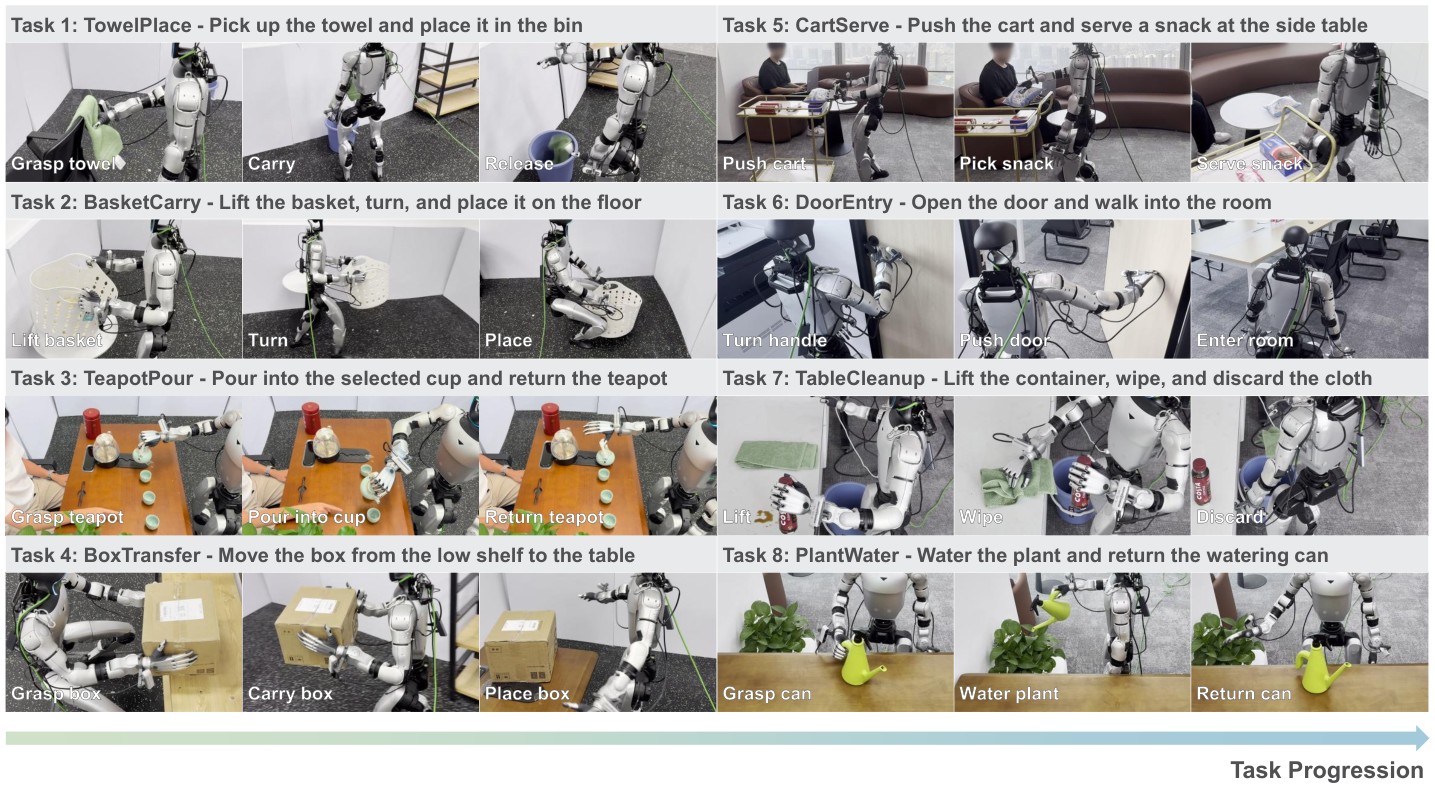
On hardware, 20 trials per task:
- In distribution: WholeBodyWAM 81.3% mean success versus DreamZero 57.5%. Table cleanup is close (90 vs 85). Basket carry, door entry, and box transfer jump 35 to 40 points.
- Out of distribution (moved objects, rewritten instructions): 68.8% versus 40.0%.
One OOD clip is the one I’ll remember. Shift the towel support 10 cm farther away, miss the first grasp, then step forward, rotate the torso, and grab it. The authors say that recovery is not in the demonstrations.
Ablations drop overall sim success to 86.9% without CASA, 84.7% without the unified controller interface, and 80.8% if manipulation and whole-body tokens are mashed into one stream.
Affiliations on the paper are CUHK, the University of Hong Kong, Peking University, and Φ-Institute.
A Human’s Take
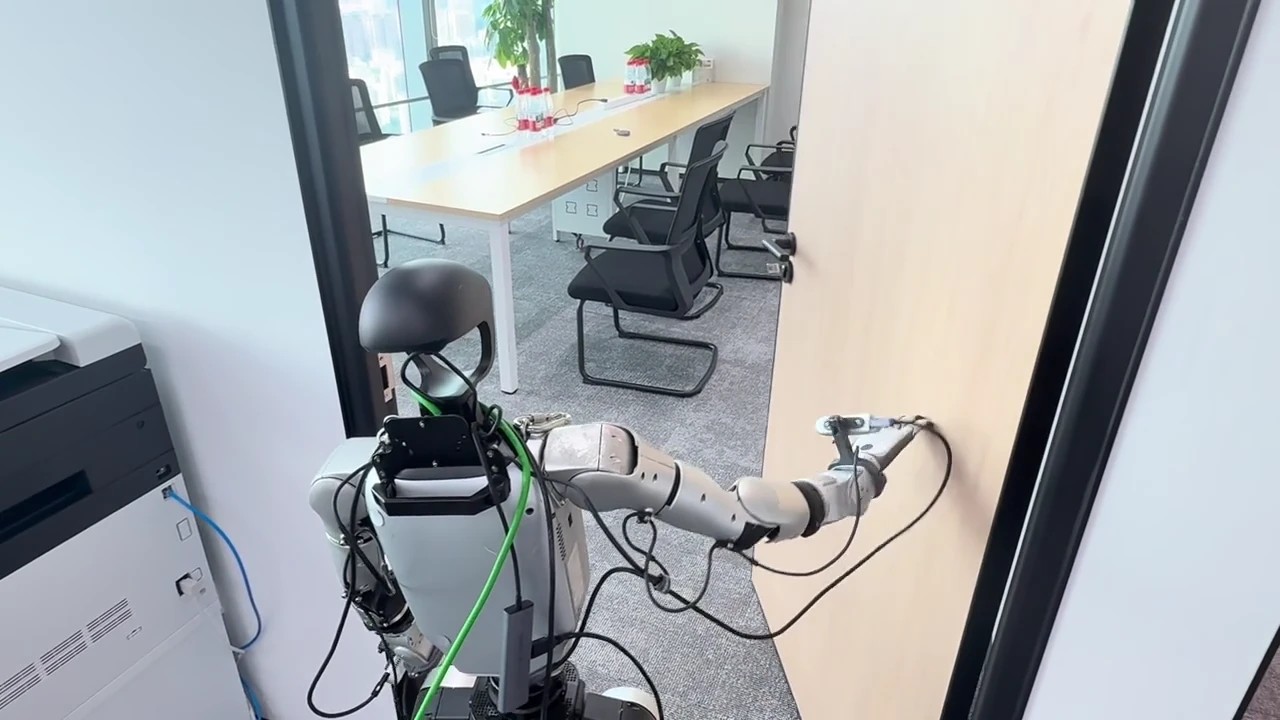
I’m so here for a G1 that waters a plant and then opens a door without swapping the entire stack. The useful claim is not “we trained a humanoid world model from scratch.” It is that the tabletop prior can stay, if you give the legs a shared command language and a gate that says now the body has to move. Watch whether that 10 cm towel recovery shows up on someone else’s G1, and whether the 70% variance cut across WBCs holds when the downstream controller is not one of the three they fine-tuned.