WISE Only Imagines When the Robot Is About to Touch Something
World models let a VLA try a move in its head before it chews the table. The expensive part is running that imagination on every timestep. Chenhao Zhang, Long Zeng, and colleagues at Tsinghua and BAAI argue you should only pay for it when the robot is about to make contact.
WISE (World-model-guided Imagination Scheduling for Efficient Post-training) landed on arXiv on 3 September. It post-trains π0 and π0.5 by sampling candidate action chunks at interaction-heavy states, rolling a frozen Open-Sora-style world model a bounded horizon, scoring those futures, and updating the policy with group-relative advantages. Imagined frames are for scoring. The gradient still sits on the real observation.
Less GPU, higher success
On five MimicGen tasks (Stack, Coffee, Square, Threading, Mug Cleanup):
- π0: 49.7% → 59.5% average (+9.8 points)
- π0.5: 52.3% → 60.2% (+7.9 points)
WISE beats π0 + DPO (53.8%) on that suite. An ablation that always imagines uses 11.45 GPU hours and 60.4% on a three-task slice. WISE hits 68.3% on the same slice in 2.61 GPU hours, about 80% fewer world-model calls and 77% less GPU time than full imagination.
A DINOv2 head predicts an interaction-relevance score from wrist and third-person views. Imagination fires only when that score clears a threshold. Uniform and random scheduling at the same budget both lose.
The robot in the room
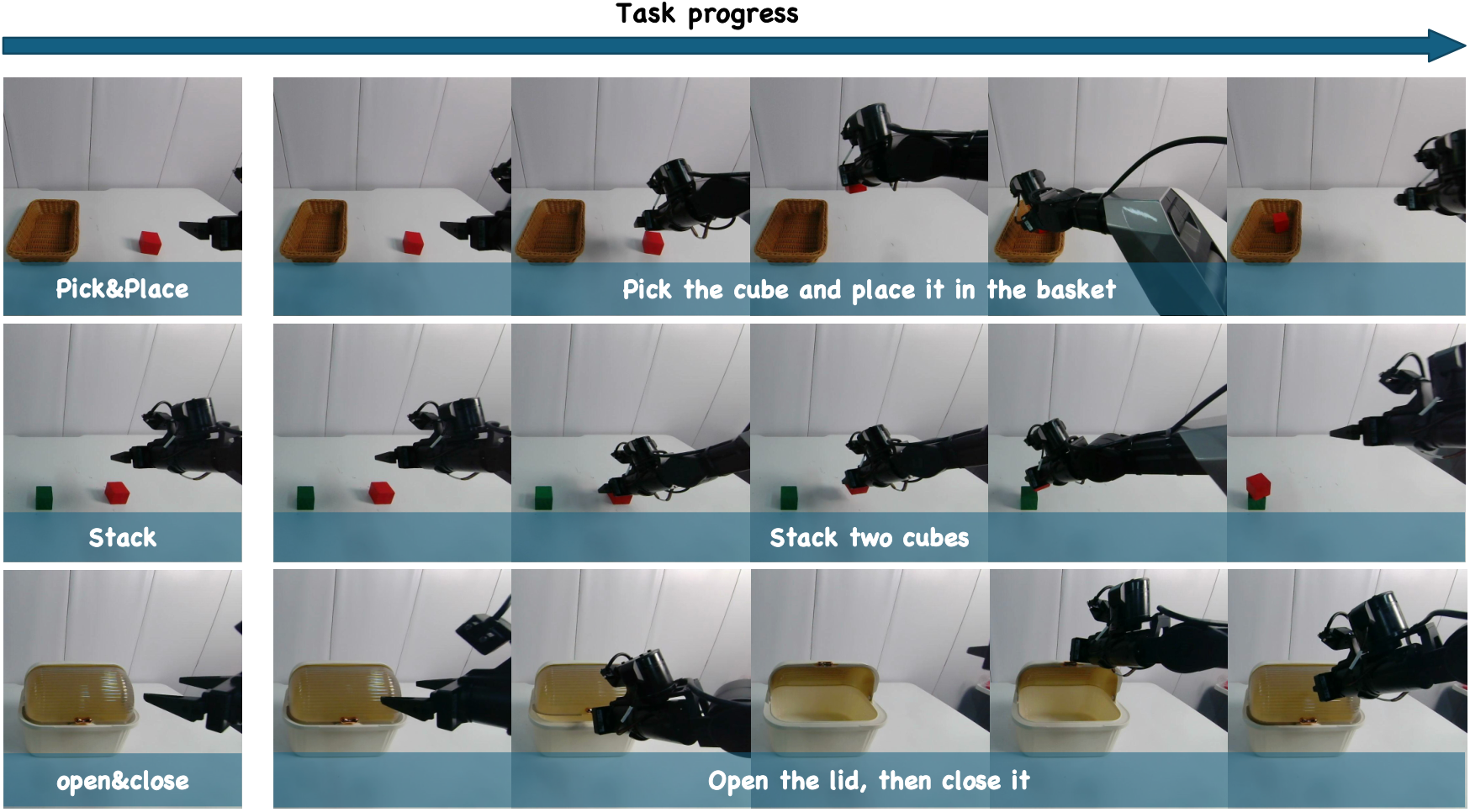
They put the same recipe on a Galaxea R1 Lite for pick-and-place, two-cube stacking, open, and open-and-close. Standard setting, average of four tasks:
- π0: 60.0% → 77.5% with WISE (+17.5 points)
- π0.5: 61.3% → 77.5% (+16.3)
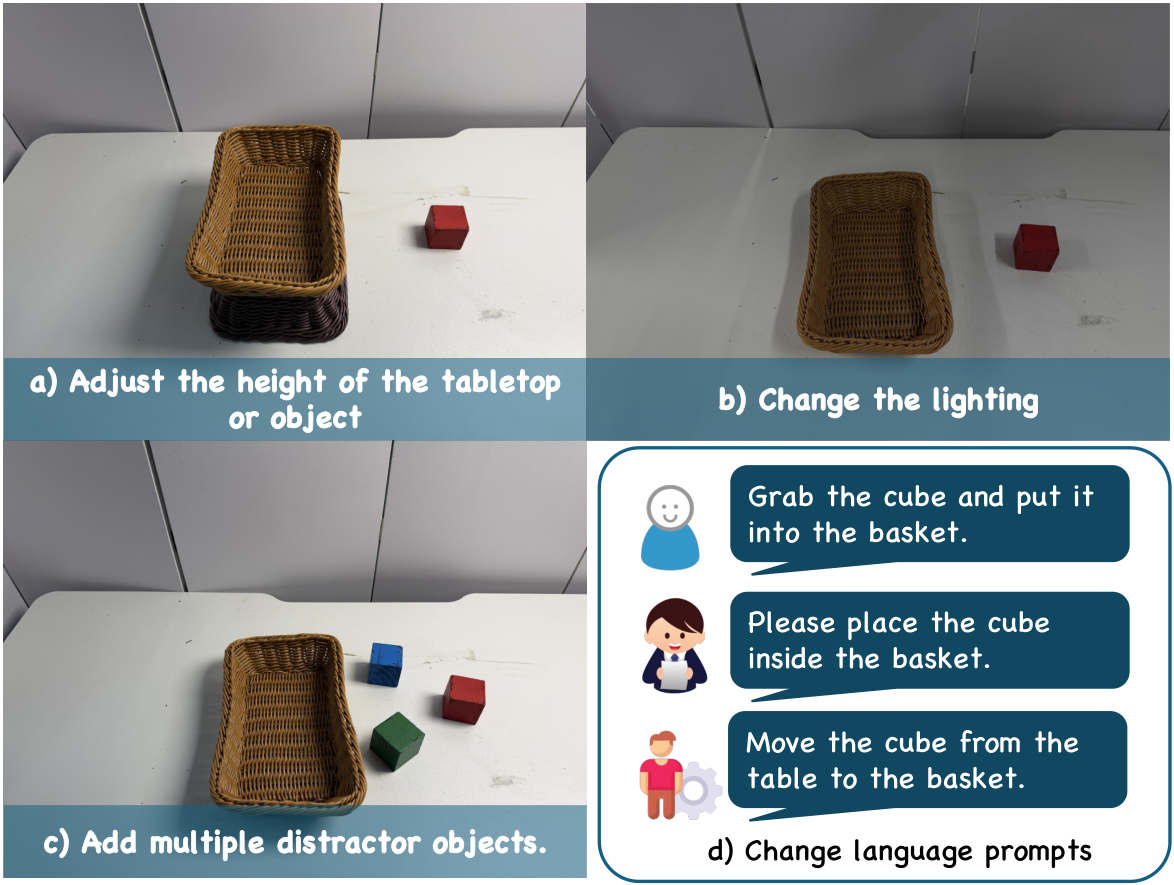
Under a generalization split (geometry, lighting, distractors, paraphrased language) the lift is larger: π0 42.5% → 68.8%, π0.5 50.0% → 71.3%.
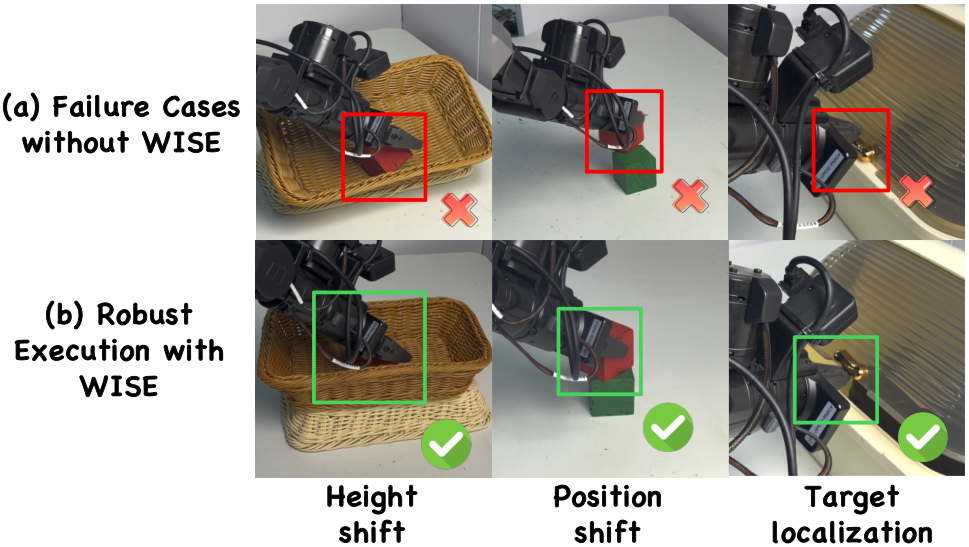
Failure stills in the paper show the baseline missing a raised basket or a shifted cube; WISE still finishes the put.
Limits they list: fixed imagination horizon, coarse stage labels for the scheduler, and a lab robot rather than a long-horizon mobile humanoid.
A Human’s Take
Imagining every frame is a tax. Scheduling imagination for the grasp and the lid is closer to how a person actually thinks: walk over on autopilot, then pay attention. The 80% compute cut is the number that makes this usable. I still want a public checkpoint, because “we post-trained π0 in our lab” is easy to overfit to four table tasks. If the scheduler holds up on a messier kitchen, this is the right way to spend world-model FLOPs.