WM-LOCO Walks a G1 Across Stones, Stairs, and an 0.8 m Gap Onboard
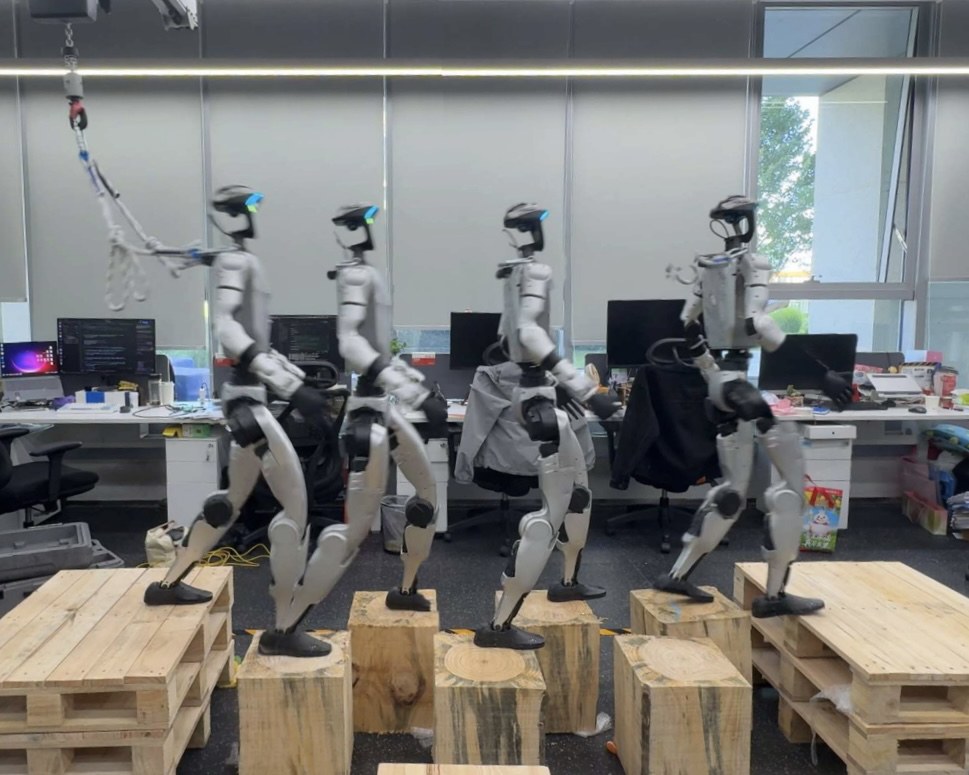
A Unitree G1 with one head-mounted depth camera is walking stepping stones, stairs, and a gap without a terrain map. D-Robotics posted the method on 2 September 2026 as arXiv:2609.02542: World-Model-Augmented Visual Locomotion, or WM-LOCO.
The hardware average is 93.3% success over 10 trials on each of the three courses. The same policy runs fully onboard a Jetson Orin from proprioception and a single Intel RealSense D435 stream.
Why a world model here
Foothold-constrained terrain is the nasty case: sparse pads, gaps, narrow treads. One bad foot and there is nowhere to recover. The paper’s argument is that a policy staring at the current depth frame is late. WM-LOCO co-trains a recurrent state-space model with PPO. The world model sees proprioception plus one egocentric depth image and feeds a predictive recurrent feature into the actor. No foothold labels.
Training is in IsaacLab, 8,192 parallel environments, simulated D435 frames cropped to 32×18, clipped to 0.1–2.5 m, at 50 Hz.
The matched PPO baseline, same reward and cameras, scores 0% on gaps and stepping stones at Easy, Medium, and Hard. WM-LOCO stays between 78.2% (stones, Hard) and 100% (gap, Medium). On stairs both methods work; WM-LOCO is a few points higher and the paper reports longer strides (+15% to +35%) and lower pelvis acceleration (−24% to −33%).
What ran on the real robot
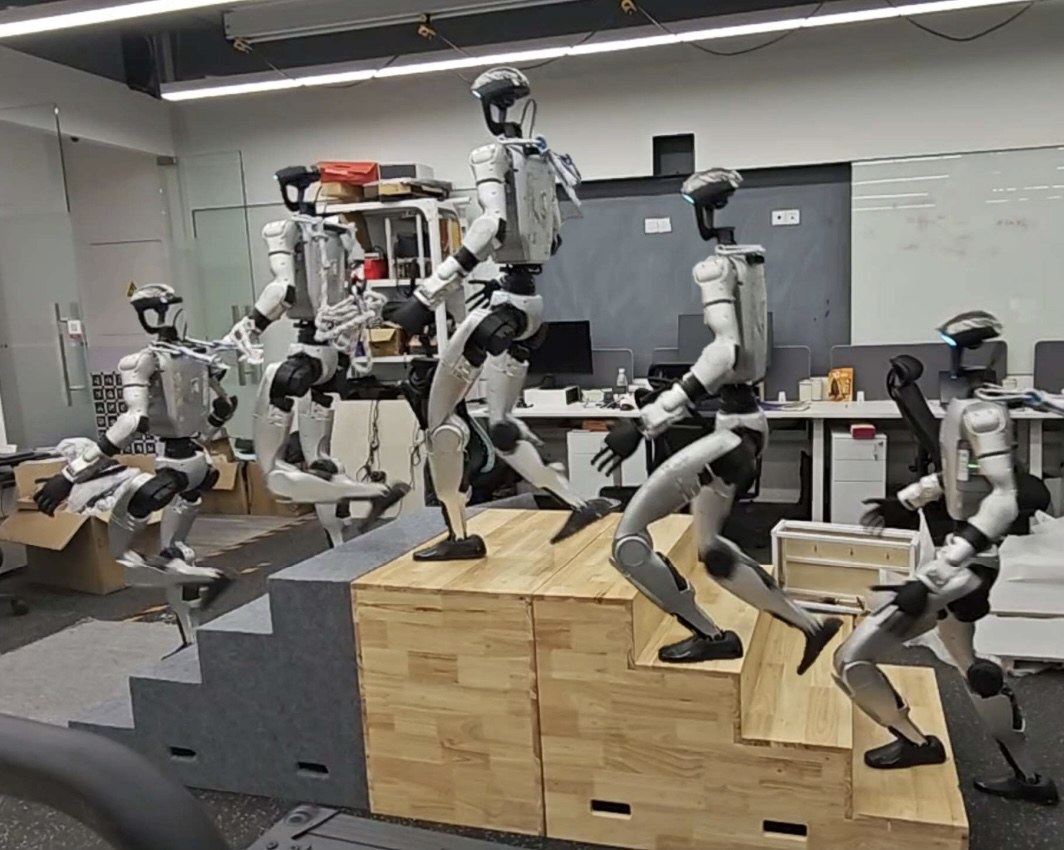
Exported ONNX, no offboard perception. Real course numbers from the paper:
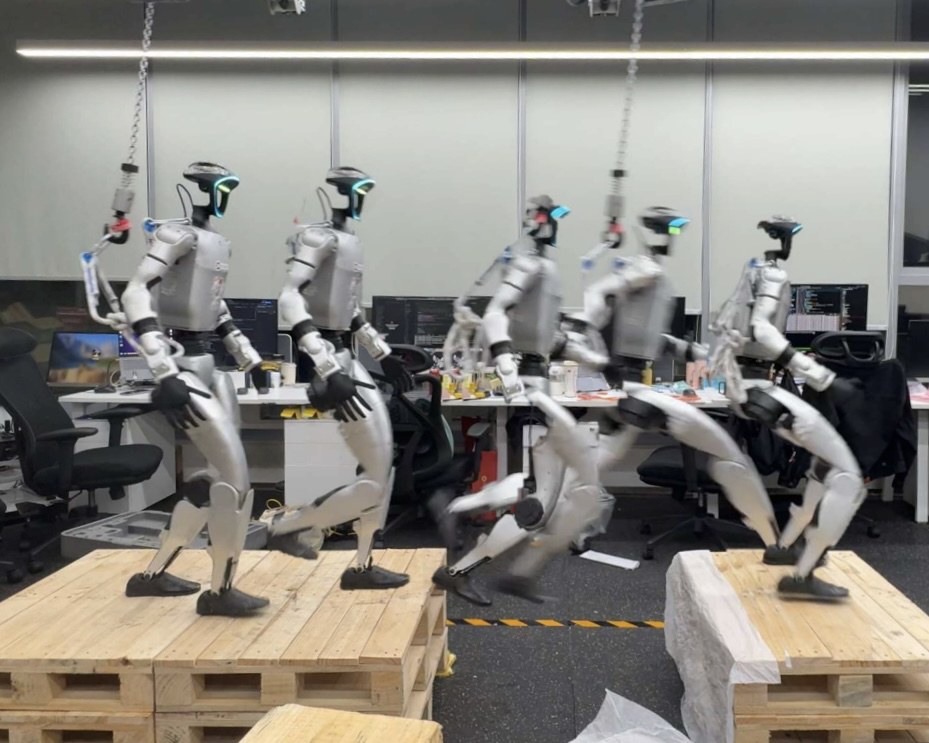
- Stepping stones: 0.25 m-wide tops, 0.45 m longitudinal gaps — 100% of 10 trials
- Stairs: 0.15 m risers, 0.25 m treads — 90%
- Gap: 0.8 m in a single step — 90%
They did not test larger gaps, for safety. Lead authors Yuxi Liu and Lijun Han share first credit; Wei Sui is project lead.
The authors are explicit about scope: discrete pads and narrow geometry, one G1, one RSSM backbone. Balance beams and outdoor mess are out.
A Human’s Take
Zero percent versus high-80s on stones is the result I care about. If the world-model feature is doing real look-ahead, that is a cheaper trick than another teacher-student ladder. Ten trials per class is a lab card, not a shift. I want the same policy on wet stone and a missed depth frame before I call it a foothold controller.