MIT Workspace Tokens Remember the Cubes Without a VLM in the Loop
If a robot has to remember that the fifth cube already went in the bowl, feeding it the entire video history is a good way to teach it the wrong shortcut. Workspace models, a CoRL 2026 paper from MIT (Dashora, Chen, Shenfeld, Marangola, Agrawal, Simchowitz), train a small latent instead: burn a VLM at train time to label what mattered, then deploy a token you can query in tens of milliseconds.
The paper went up 17 September.
Saliency at train time, a token at test time
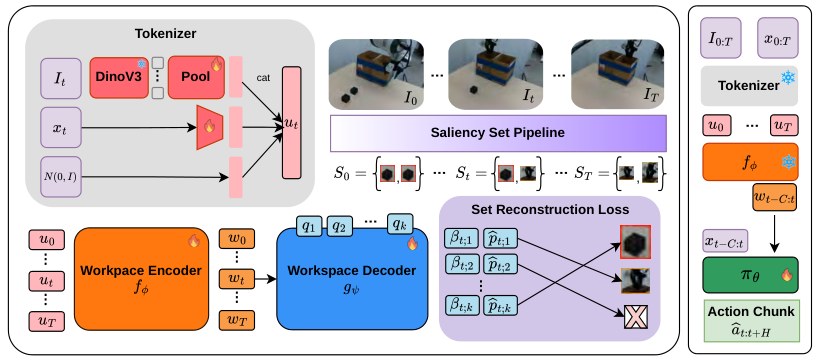
Qwen3-VL-8B flags frames that contain events worth remembering. MolmoPoint then points at objects. Those points become DinoV3 patches, capped at m patches per timestep: the salient set. A causal transformer encoder writes a workspace token each step. A DETR-style decoder has to reconstruct that set (Hungarian match + occupancy), so the token is forced to hold the patches, not a vibe.
Then they freeze the encoder and train a Diffusion Policy on a short history of workspace tokens plus proprioception. No VLM at deployment.
Latency on their stack (Table 1): vanilla Diffusion Policy 41.3 ms; workspace with batching and KV cache 49.2 ms (1.19×); a keyframe baseline that queries a VLM online 302 ms (7.31×), or 199.5 ms batched.
Four memory chores
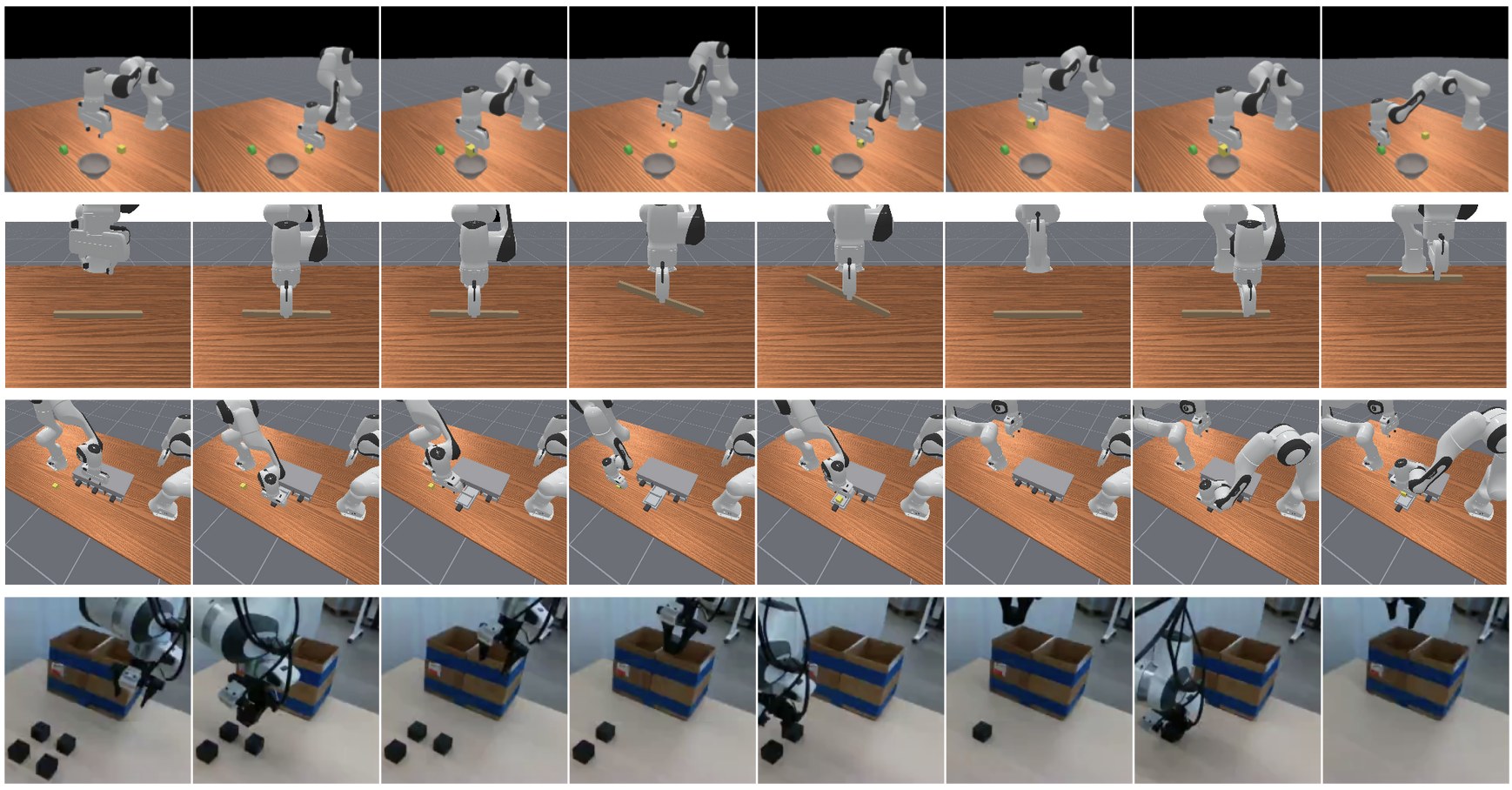
Simulation is ManiSkill3 on a Franka Research 3. Hardware is a Franka FR3 with an AgileX jaw and a D435.
- CubeDrop: put exactly five cubes in a bowl that hides them
- HalfAndHalf (real): split K∈{2,4} cubes into two occluding boxes
- DrawerRecall: another robot hides a cube in one of three drawers; the policy must open the right one
- BalanceBar: lift a bar with unknown center of mass, then regrasp at the CoM
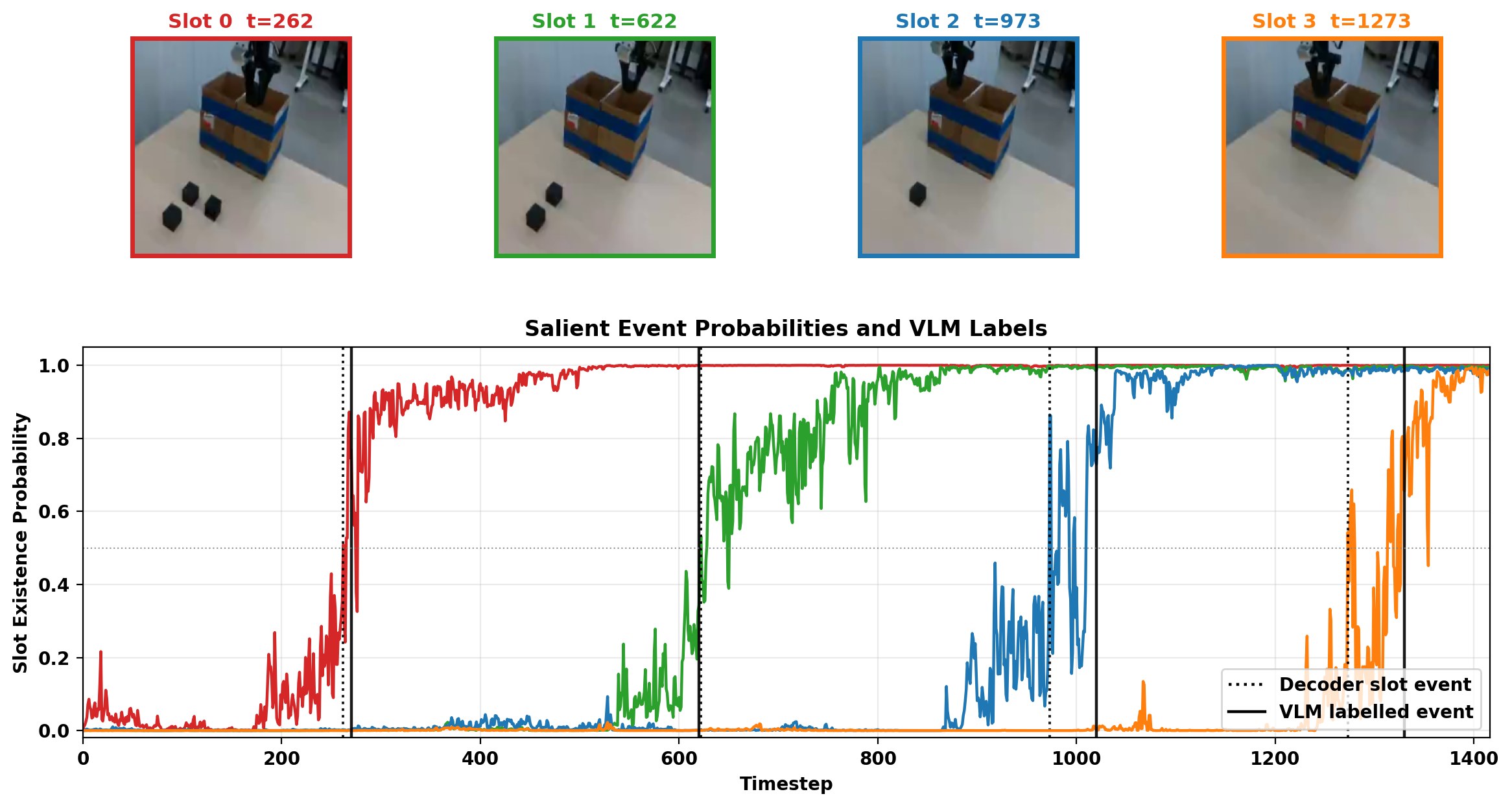
Across those four, workspace averages 91.5% ± 2.2 success vs 66.8% ± 3.2 for the keyframe VLM-in-the-loop baseline (N=100 sim, N=20 real). The surprise is not only speed. Keyframe and full-history stacking pick the right mode and then miss the handle or freeze. The authors blame aliased frame stacks. Workspace tokens, they show, move smoothly in PCA and fire decoder slots a little early or late around the true event, which looks like regularization.
They are clear this is one instantiation: patches, not language traces, and a quadratic transformer that will hurt at very long horizons.
A Human’s Take
Paying Qwen once per demonstration and then running a 49 ms encoder is the kind of asymmetry robot labs can actually afford. Beating the live VLM on success, not just latency, is the twist. Next I want this token on a mobile manipulator that leaves the table, with the same “did it remember, or did it miss the grasp?” split.