TwinDEX Matches a Wearable Hand to the Robot So Data Doesn’t Need Retargeting
X Square Robot introduced TwinDEX on 2 September 2026: a wearable three-finger exoskeleton and a robot hand that share the same nine degrees of freedom, seven of them active. The bet is that if collection hardware and deployment hardware look and move alike, you can train a policy without parking a robot in the capture booth.
The Shenzhen company posted a project page and a PR Newswire note the same day, plus a four-and-a-half-minute demo.
Same fingers, both sides
Both devices use a thumb, index, and middle finger. The project page says the team scored candidate morphologies on eight manipulation primitives and settled on seven active + two passive DoF as the cost/reliability trade: more fingers help, then the packaging and torque budget get ugly.
The page spells out the split:
- Thumb: four DoF, three active (CMC flexion/abduction, MCP flexion). IP is a passive four-bar off the MCP.
- Index: three active DoF (MCP flexion and abduction, PIP flexion).
- Middle: active MCP, passive PIP via another four-bar. The shell is wide enough that the operator’s middle, ring, and pinky share that finger so the worn rig still looks like the robot.
PR Newswire lists the same architecture and adds the alignment list: kinematic chains, joint axes, link proportions, contact geometry, surface materials, visual appearance, and sensor placement. Finger states are meant to map straight into robot joint space.
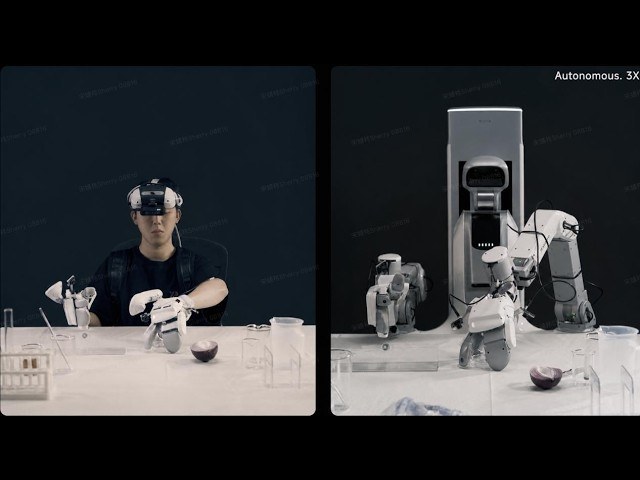
The capture stack records multi-view RGB, six-DoF wrist poses, joint angles, and fingertip tactile signals, with measured delays so training observations line up with deployment timing.
Chemistry without on-robot demos
The headline demo is a standardized chemistry experiment run in one uncut take. PR Newswire counts 24 sub-actions (open and stabilize containers, thin scooper, rubber-bulb pipette, liquids and solids, a nearly transparent glass rod, pour, tool switches, two-handed work). The project page says 25 in one paragraph and 24 in another. I am treating it as a long, contact-rich lab sequence, not a precise 24-vs-25 score.
Both sources say the policy was trained from scratch on a few hundred robot-free episodes, with no on-robot training data. On a collection benchmark, TwinDEX reports 5.3× effective throughput versus on-robot teleoperation, and “≈1:1” learning efficiency against the same number of on-robot demos.
Everyday eval tasks listed in the press note: cap twisting, broom-and-dustpan sweeping, sliding out and opening a book, toolbox latches, syringe work.
A Human’s Take
Matching the glove to the hand is the interesting hardware move. If the 5.3× collection number holds outside a staged lab, this is how you stop treating every dexterous demo as a scarce robot-hour. I still want to see the “few hundred episodes” count published as a table, and whether a new kitchen or a new bottle shape needs another hundred.