X-WBC Trains One Whole-Body Brain Across Nine Humanoids
Most whole-body controllers are one robot, one policy. X-WBC, accepted at CoRL 2026, treats several humanoids as a joint data source. Juntong Zhang (Tongji University), Chun Gu, and Li Zhang (Fudan University), all also at the Shanghai Innovation Institute, posted the paper 14 September.
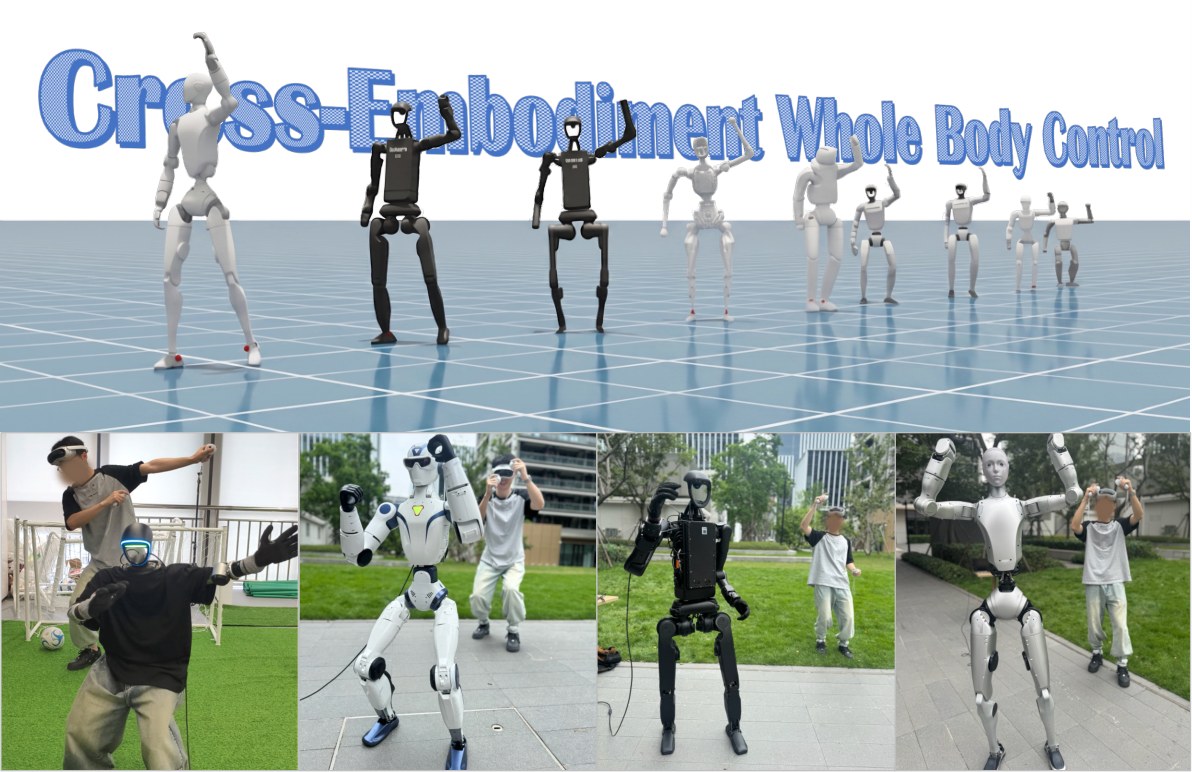
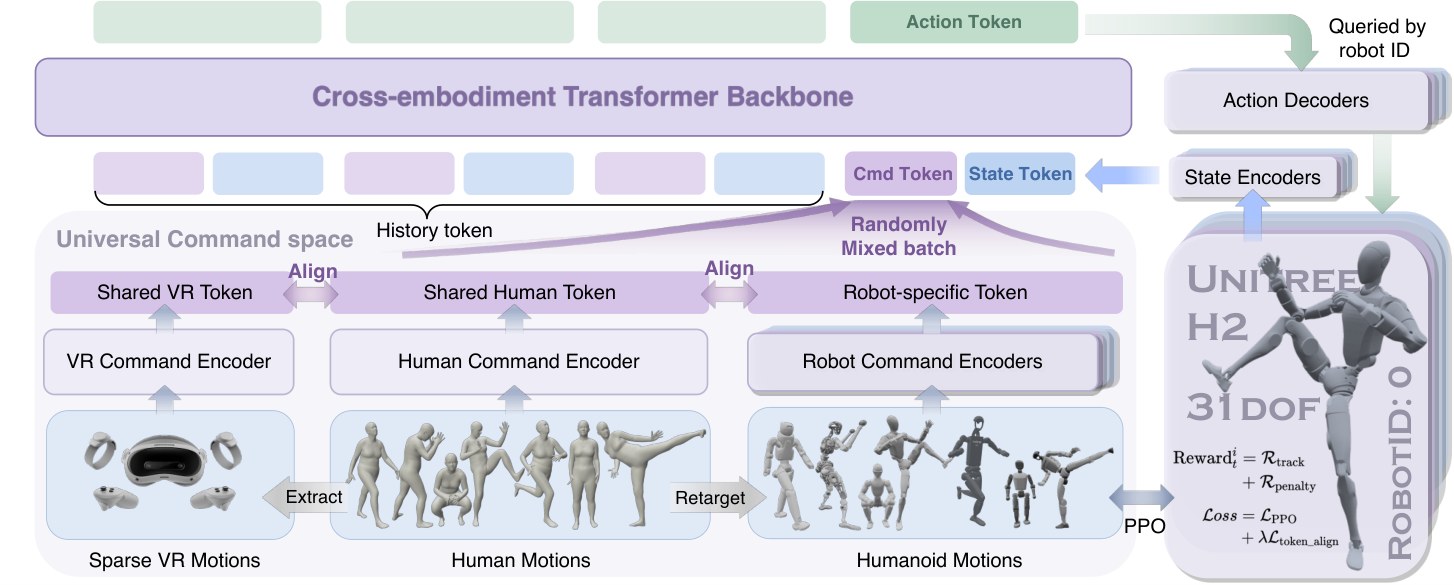
The claim is simple: walking, kicking, and squatting share temporal structure across bodies. The kinematics, joint limits, and actuators do not. So they split the problem. A shared causal Transformer learns motion semantics. Lightweight robot-specific modules map that into each robot’s proprioception and action space.
Three ways to say the same motion
Commands land in a human-centered token space from three routes:
- Full human motion as the semantic anchor
- Robot reference motion after retargeting
- Sparse VR: five keypoints, head plus four limb endpoints
During training, one of the three tokens is sampled 1:1:1 per episode. An alignment loss pulls tokens from the same clip together before they enter the backbone. At deployment, a VR headset can drive the robot without a full motion-capture suit.
Training runs in Isaac Lab on nine embodiments: Unitree G1 variants, H1, H1-2, R1, H2, plus Fourier GR3, Booster T1, and Adam Lite. The motion diet is about 200 hours of BONES-SEED, resampled at 50 Hz. Policies mix all robots into one PPO batch. The final model trained about two days on 8 NVIDIA H100 GPUs, 1024 parallel environments per robot.
On BONES-SEED training motions, the full Transformer hits 98.60% success on G1 and 93.22% on H2. A shared MLP lands at 97.70% / 91.33%. Single-robot Transformers sit at 97.69% / 92.22%. The authors treat those as in-distribution architecture numbers, not a claim that an unseen body just works.
On a frozen 100STYLE grid of 800 clips (133.02 minutes), X-WBC with five-point VR commands completes 729 clips (91.13% SR). Released SONIC scores 93.00%. TWIST scores 75.62%. X-WBC trades a little position error for longer surviving rollouts on that grid.
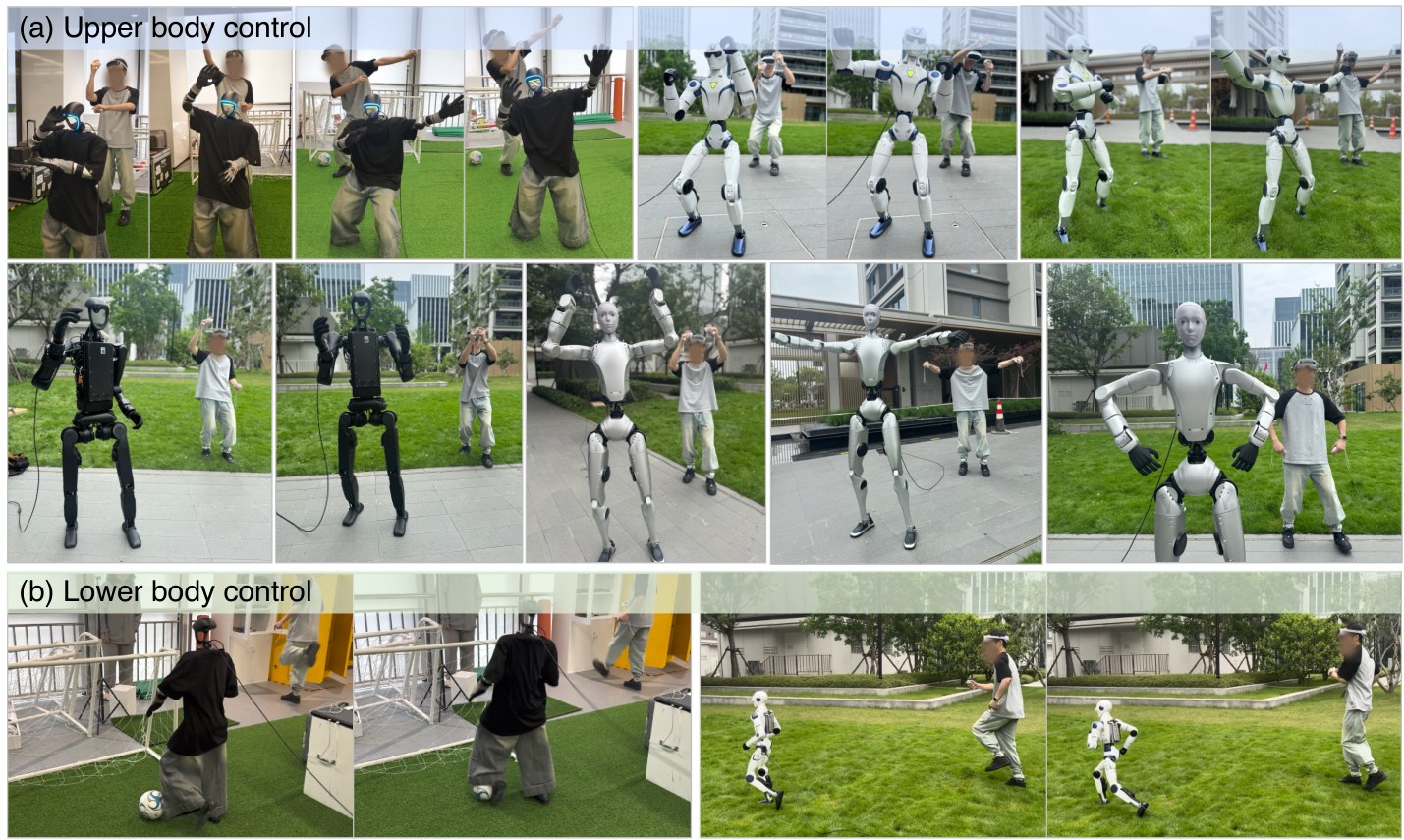
Real robots in the paper are four Unitree platforms: G1, R1, H1-2, and H2. Operators use the same sparse-VR format. Robot-specific branches handle the rest. The authors call the hardware results qualitative: soccer kicking, grass running, upper-body pose matching. Broader manufacturers and longer sequences remain open.
A Human’s Take
The part I like is the five-point VR route sitting next to full mocap in the same token space. If a Quest-scale interface can drive four different Unitree bodies from one backbone, that is a real ops win even if the success-rate bump over a single-robot Transformer is small. I still want a non-Unitree body in the hardware column before I call it a foundation model.