XEWorld Asks: Can Your World Model Draw a Robot It Never Saw?
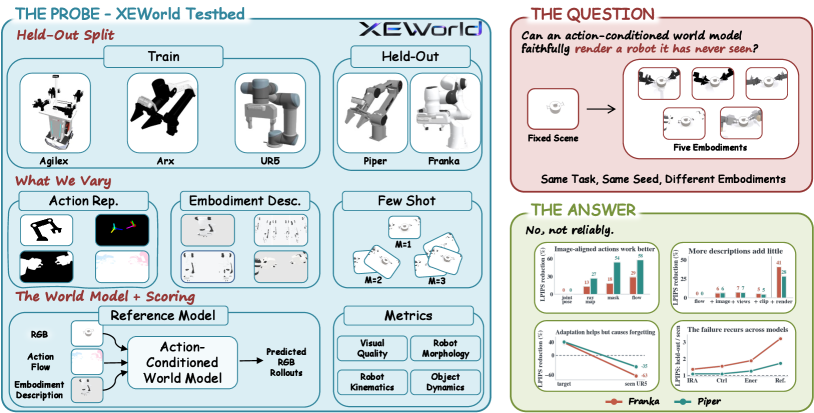
If a world model only ever rolls out the training arm, you cannot tell whether it learned physics or memorized paint jobs. XEWorld, posted August 6, 2026 (arXiv:2608.05799), is a controlled cross-embodiment testbed that freezes the scene and swaps the robot — then scores what the model invents.
The setup
Built on RoboTwin, XEWorld re-renders the same 25 manipulation tasks across five bimanual setups. In the main split, train on Aloha-Agilex, Arx-X5, and UR5; hold out Franka and Piper. Scenes, objects, lighting, and cameras are byte-identical across bodies for a given task seed — only the embodiment changes. Metrics split into visual quality, robot morphology, robot kinematics (URDF-grounded keypoints), and object dynamics.
The uncomfortable headline from the abstract and analysis: generation quality tracks visual appearance distance (r = 0.812 in LOEO folds), not kinematic workspace distance (r = 0.549, unstable). Models behave more like 2D pattern matchers than kinematics engines.
What actually helps (and what does not)
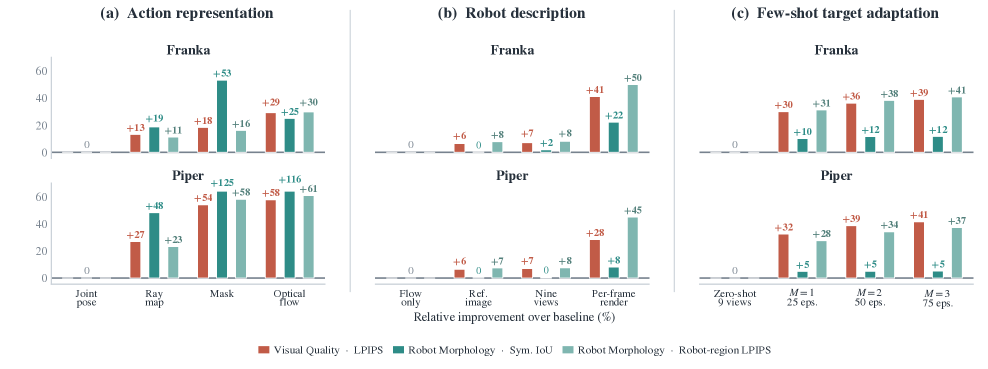
Pixel-space action representations beat numeric joint poses. Swapping joints for optical flow cuts LPIPS error by 29% on Franka and 57% on Piper in the reported table, with large morphology gains. Masks preserve silhouette best; flow wins overall LPIPS.
Richer static descriptions (one image → nine views → articulation clip) mostly saturate after the first reference. A per-frame robot render aligned to the motion is the intervention that actually recovers identity (robot-region LPIPS cuts of 50% / 45% on Franka / Piper vs flow-only in the paper).
Few-shot fine-tuning with one demo per task (25 episodes) recovers a lot of target appearance — and spikes error on previously seen UR5 by 69% LPIPS in the reported forgetting plot. The authors also show IRASim, Ctrl-World, and EnerVerse-AC all degrade on held-out bodies after fine-tuning on the same testbed data.
A Human’s Take
This is the paper that makes me side-eye every “world model as simulator” slide. If the network needs a perfectly aligned silhouette stream to paint an arm it has never seen, we are not shipping general physics yet — we are shipping fancy video completion with a control cable. Designers who care about multi-robot fleets should read the pixel-space and forgetting sections before scaling demo collection.