XR-2 Trains on 1,500 Hours of Two-Handed Housework, Then DAgger
Bimanual household work is still starved for data that looks like a Tuesday laundry pile. A PrimeBot / Peking University / Crobotia team posted a dump on 3 September: 1,500 hours of two-handed demos, a 5B-parameter VLA they call XR-2, and a scaling plot that actually bends.
The robot is the X2W: two 7-DoF arms with 1-DoF grippers, a 4-DoF waist, a 2-DoF head, and a three-wheel omni base — 25 control variables, states logged at 30 Hz. Cameras: a RealSense D435i, ZED X Mini, and two ZED-XONE GS wrists, plus dual Jetson AGX Orin compute in the diagram.
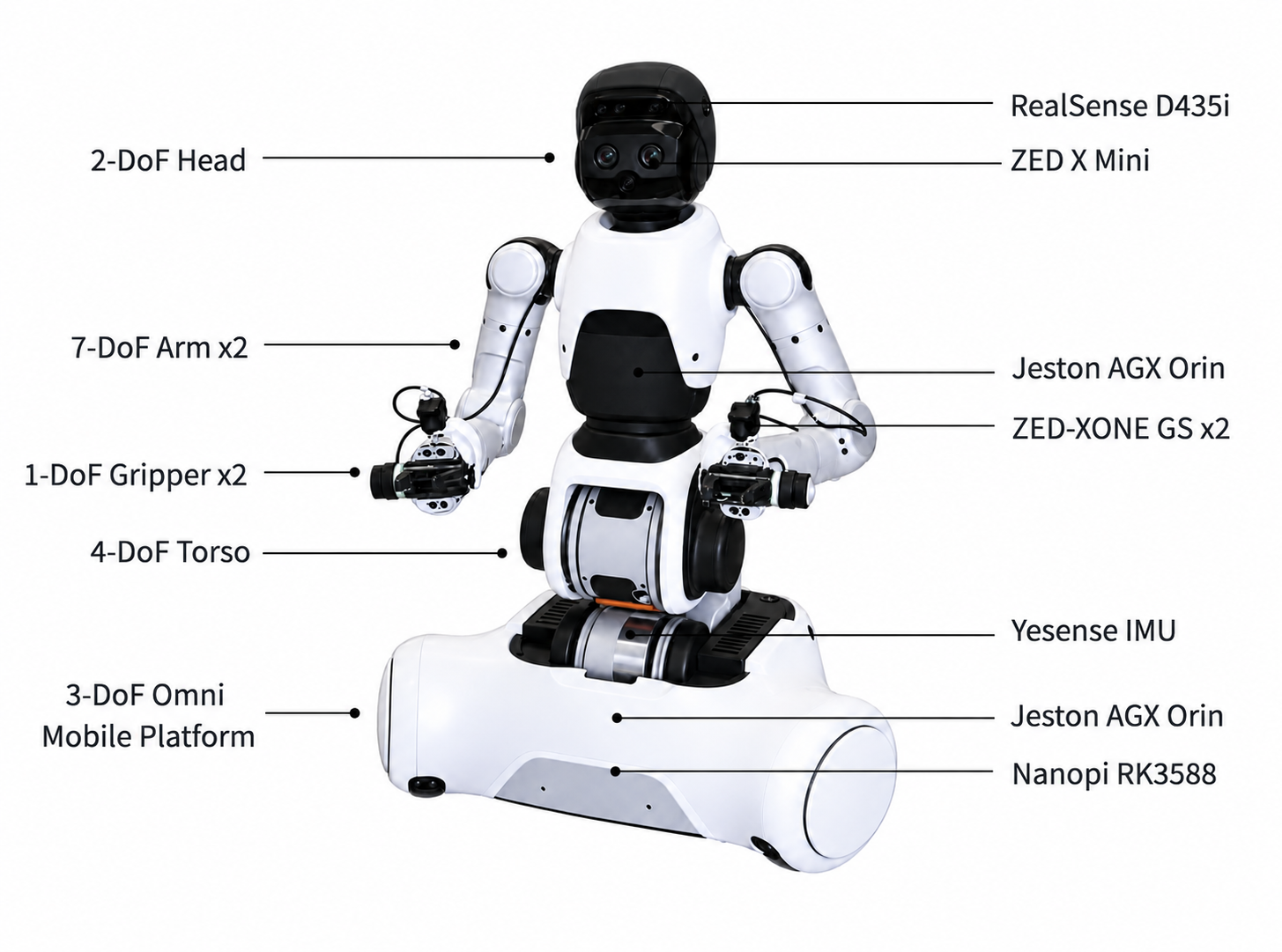
Two pipelines, one pile of clothes
The real-robot slice is 32,518 teleop trajectories, 57.4 million frames, 531.7 hours, frame-level language. Four scenes: folding station (~14.6k traj), washer (~8.4k), sofa (~6.1k), laundry basket (~3.4k). Some episodes run past 150 s. After merging equivalent instructions they list 11 atomic skills; fold-clothes alone is 14.6k.
The UMI slice is about 1,000 hours of handheld-gripper folding, from more than 200 households and 100 collectors, covering 5,000 garments. Dual 960×960 video at 30 Hz, metric 6-DoF trajectories from visual-inertial SLAM, gripper aperture from vision, no encoders on the jaws. Sessions can run 90 minutes without a reset.
XR-2 is a Mixture-of-Transformer: Qwen3-VL-4B-Instruct plus an 18-block flow-matching action expert (hidden 1024, 8 heads). Deployment: RTX 4090, async inference at 10 Hz, action chunk 50×25, commands issued at 30 Hz after a 1000 Hz whole-body controller.
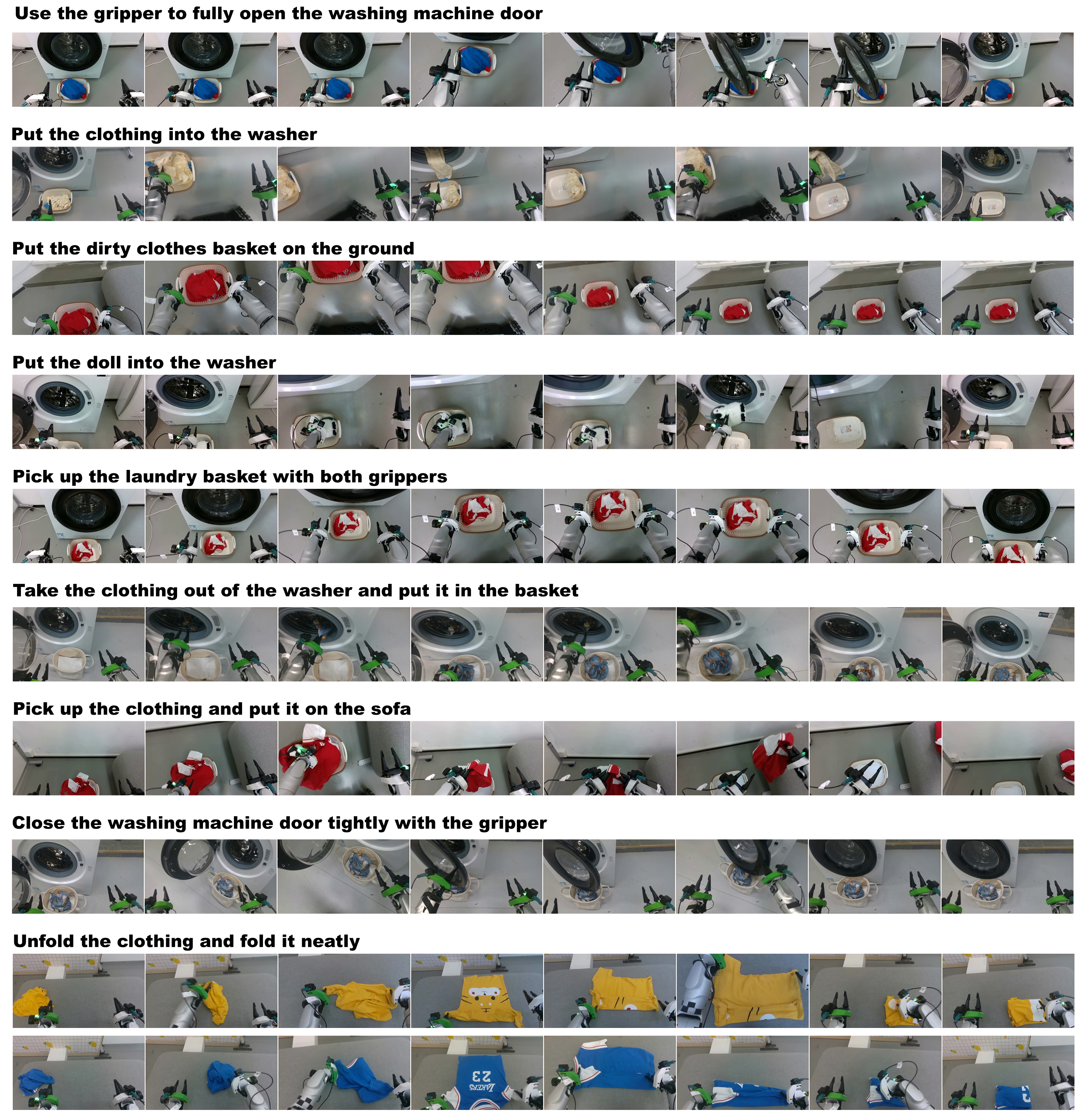
Expert data saturates. Corrections do not.
On clothes folding, success climbs from 34% at 30 hours of expert data to 84% at 120 hours, then 82% at 160 hours. Extra expert hours stop helping.
DAgger starts from a checkpoint trained on 18,695 expert trajectories across 10 sub-tasks (58% on folding). Three rounds, 2.5 epochs each, with extra correction budget on the weak sub-tasks: 74%, 82%, 93%. That is a 35-point lift over the expert-only start.
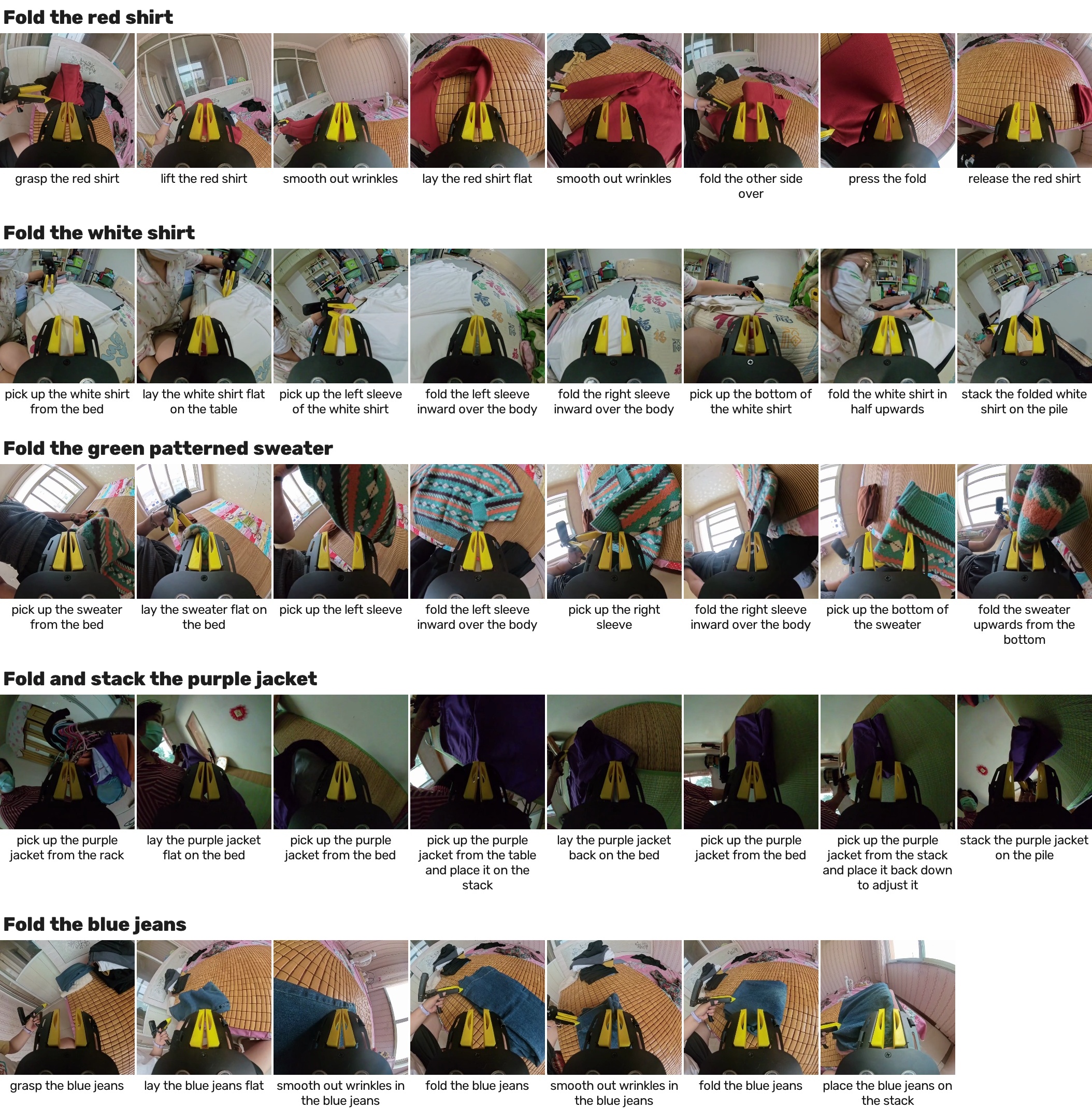
The authors say a model at 85% under their slight generalization (size, color, start pose) clears 95% in-distribution. Data and a URDF live on Hugging Face. A change log in the paper says full data and an IROS 2026 household bimanual challenge launched in July 2026.
A Human’s Take
A thousand hours of people folding shirts in actual bedrooms is the part I would steal. The robot hours are the part I would trust for a washer door. Putting both under one VLA, then admitting expert data saturates at 120 hours on folding, is the adult version of “just scale the demos.” If you are collecting, the next dollar is probably a human with a deadman switch, not another tidy teleop take.