ZEST Puts Army Crawls and Breakdances on Atlas, Zero-Shot
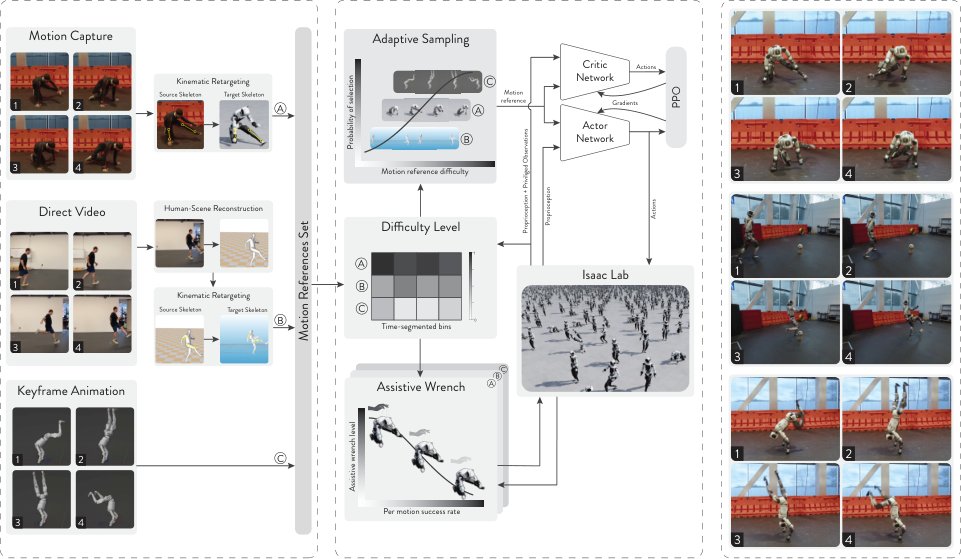
RAI Institute and Boston Dynamics put a single motion-imitation recipe on three very different machines: electric Atlas (~1.8 m, 100 kg, 30 DoF), Unitree G1 (~1.2 m, 35 kg, 29 DoF), and Spot (12 DoF, 33 kg). The paper, ZEST (Zero-shot Embodied Skill Transfer), is the cover story of the August 2026 Science Robotics humanoid issue. Policies train in simulation and run on hardware with no extra fine-tuning.
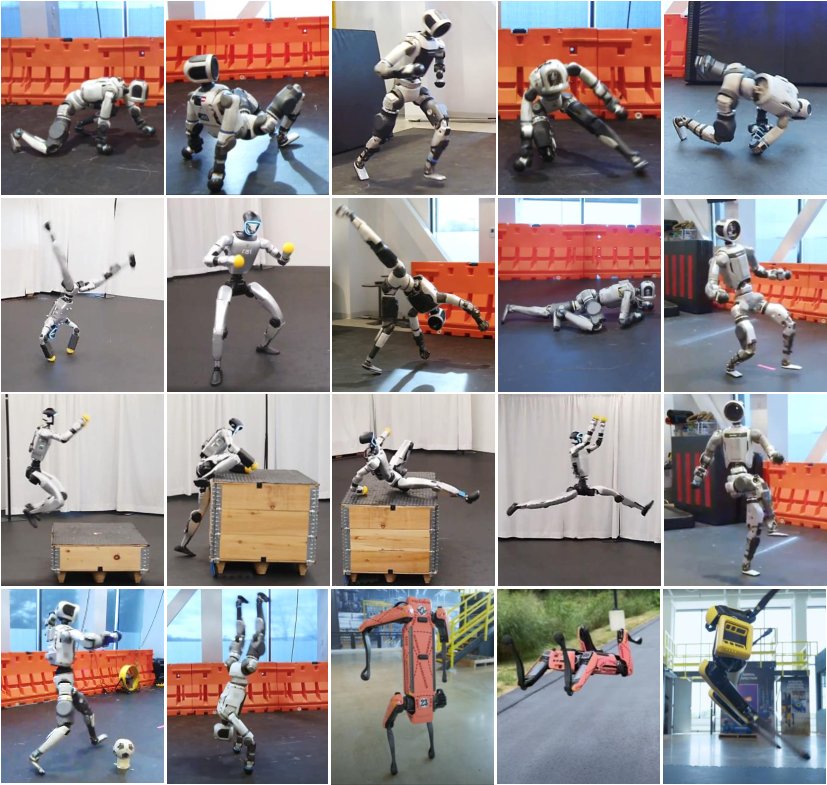
On Atlas, motion capture becomes army crawls, breakdancing, cartwheels, and forward rolls. Phone video becomes soccer kicks, dance snippets, and box climbs on Atlas and G1. Keyframe animation gives Spot a continuous backflip and a barrel roll.
One recipe, three data pipes
ZEST trains a feedforward policy on the next-step reference plus current proprioception. It outputs residual joint targets for a PD controller. The authors skip contact labels, long observation histories, future-reference windows, and a state estimator.
Two training tricks do most of the work:
- Adaptive sampling: clips are split into bins; hard segments get more resets
- Assistive wrench: a model-based base wrench that starts strong on wild motions and anneals to zero
Each specialized policy took about 10 hours (~7,000 iterations) on one NVIDIA L4. The paper also describes simplified models of Atlas’s parallel-linkage actuators so Isaac Lab can run those closed-chain joints without paying full closed-loop cost.
What actually ran
Interesting Engineering, covering the Science Robotics issue, repeats the hardware list: crawling, rolls, cartwheels, and breakdance on Atlas; dancing, soccer kicks, and box climbing from video; backflip and barrel roll on Spot from animation. The paper reports tracking errors per skill. Walk and jog on Atlas stay tighter than the multi-contact set. Box climb-up on G1 succeeded five times in a row at the 0.75 m training height and still worked with a 2 kg torso payload.
In simulation, a multi-skill Atlas policy beat Boston Dynamics’ whole-body MPC on jog and cartwheel. MPC could not run handstand invert, roll-on-all-fours, or a noisy dance clip because those contacts sit outside its foot-and-hand schedule.
Limits are stated plainly: flat, non-slippery terrain; no test of unseen motions; sim-to-real still depends on a decent actuator model.
A Human’s Take
The interesting part is not another backflip clip. It is that the same small MDP ran army crawl on a 100 kg Atlas and a video-to-box-climb on a G1 without a contact schedule. That is the thing model-based stacks still choke on.
I still want the unedited failure log. Ten hours per specialized skill is cheap by lab standards and expensive if you need a library of a hundred. If they can make the multi-skill policy as consistent as the single-skill ones, this starts looking like a real behavior factory.