Meta’s Fiber-Optic Glove Tracks a Whole Hand at 60 Hz Without Cameras
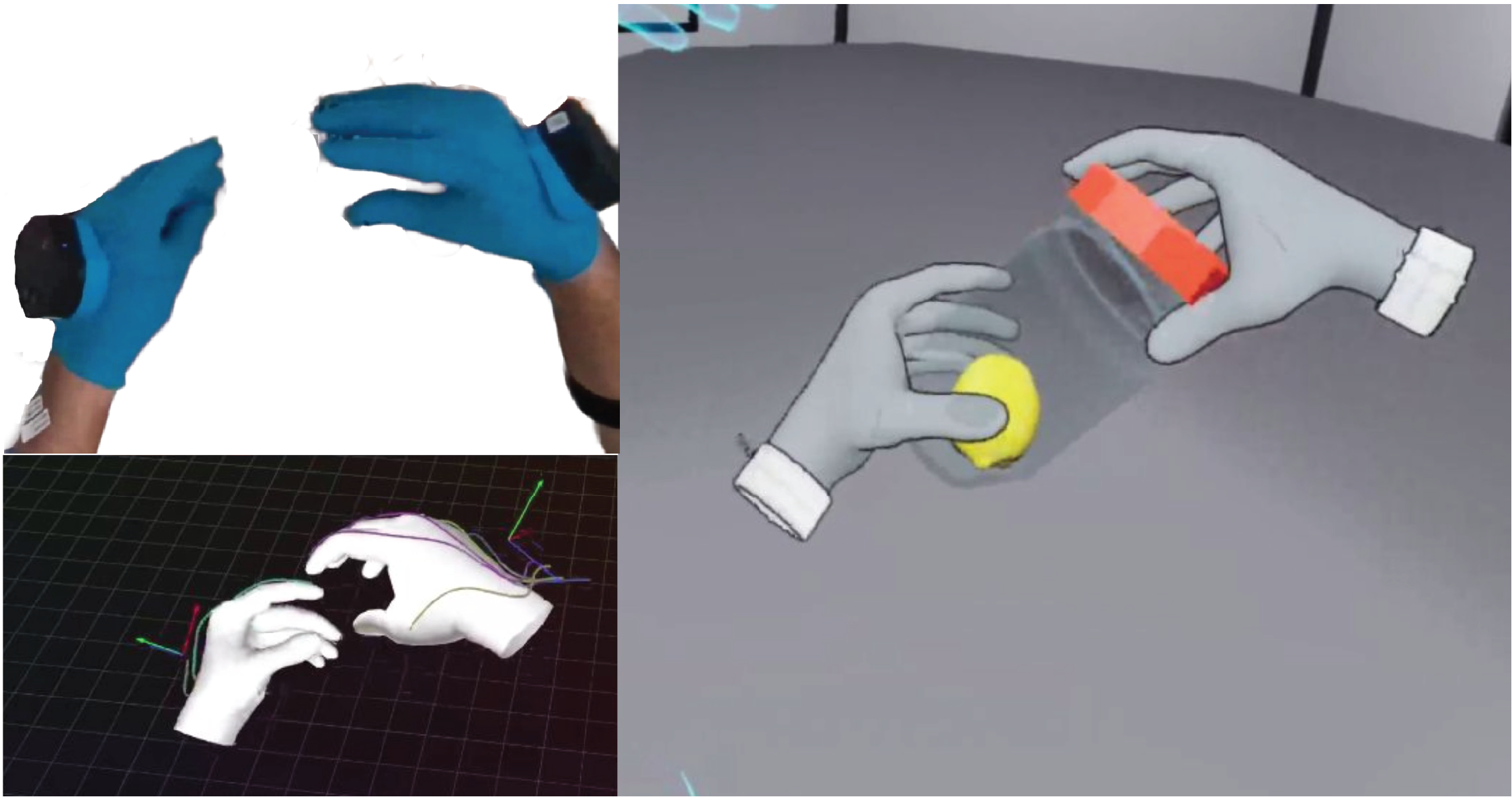
Hands disappear behind a mug, a box, or another finger, and vision trackers guess. A team from Meta in Redmond, with J.D. Peiffer also at Northwestern, posted an August 25 arXiv paper on a knit glove that ignores cameras entirely. Multi-core optical fibers reconstruct each finger’s 3D curve, then an inverse-kinematics solver poses a full hand at 60 Hz.
On a ~2-hour set of dexterous tasks across 5 subjects, mean fingertip error versus motion capture is 7.2 mm. A one-time factory calibration of the fiber routing hub drops that to 4.9 mm, and the authors say the correction transfers across users and sessions.
Fibers, not IMUs
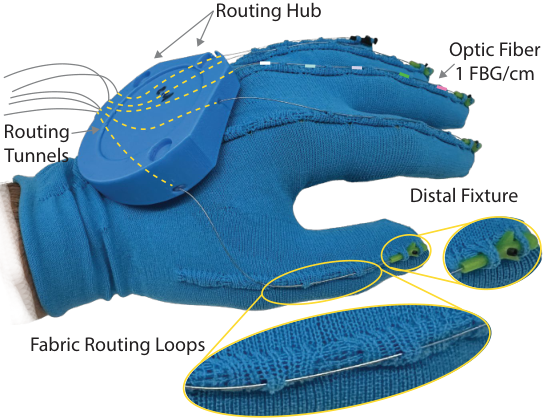
Each finger gets one 125 µm three-core fiber with 26 Fiber Bragg Gratings spaced 1 cm apart, starting 1 cm from the tip. The fibers sit in 0.4 mm nitinol tubes, run through dorsal fabric loops, and lock at a 3D-printed fingernail fixture. A dorsal routing hub with known tunnel geometry is how they register five independent fiber frames into one hand frame.
They interrogate all five fibers with an FBGS ShapeScan 905. Shape comes out at 1 mm spatial resolution and 60 Hz. Reconstruction latency on the box is 32.5 ms. Downstream, Python registration is 3.2–5.3 ms per sample; C++ inverse kinematics via Facebook’s Momentum library is 0.12 ms.
What they measured
Protocol: range of motion, then manipulation (buzz wire, box and blocks, cup stacking, in-hand rotation, 9-hole peg, squeezing). Two sessions per person with a full doff and don between. 26 mocap markers on top, 20 OptiTrack cameras around them.
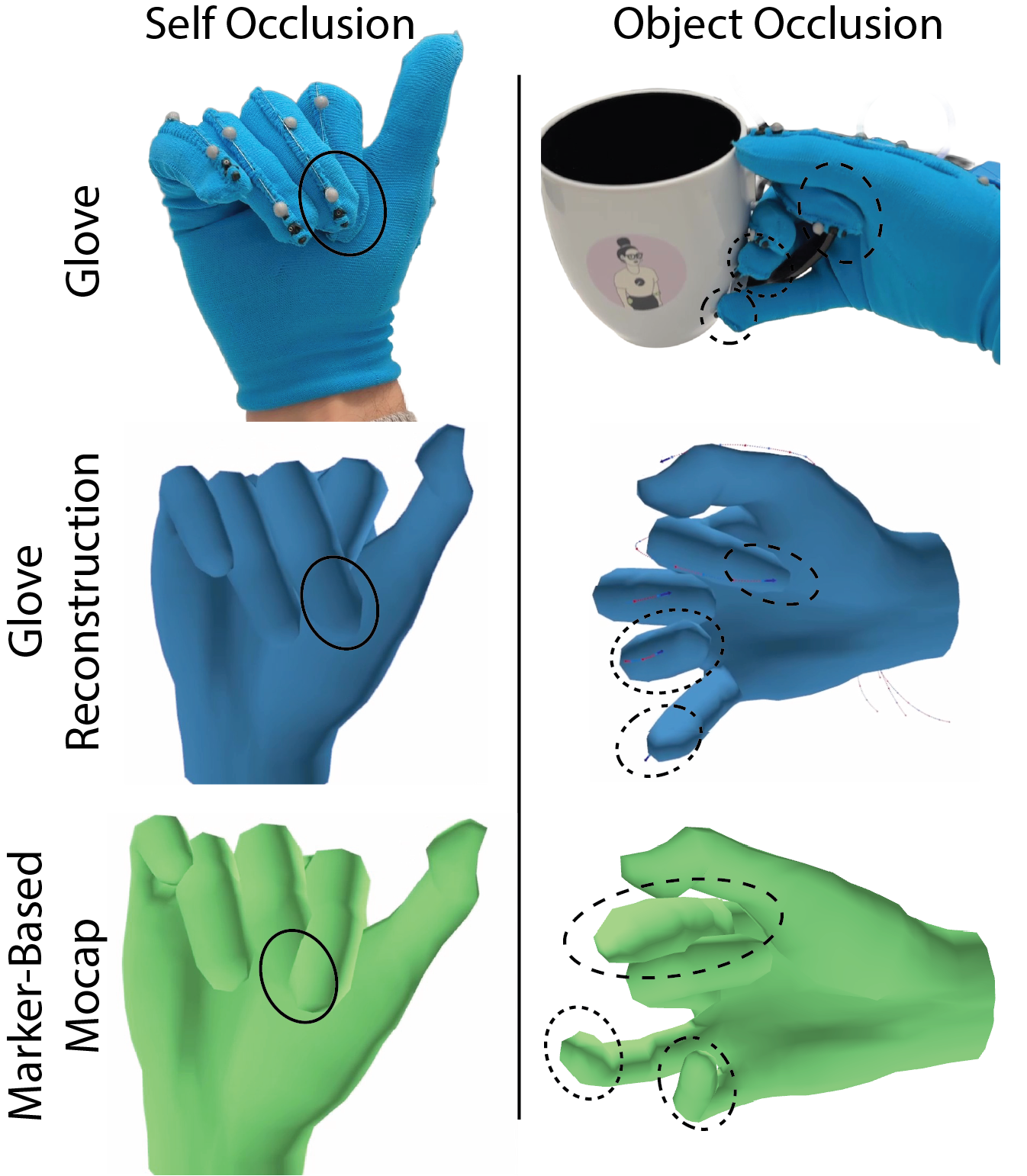
Mocap itself is the weak baseline they are replacing. 25% of range-of-motion frames and 34% of manipulation frames lost at least one marker. Their examples include crossed fingers and a coffee-cup grasp where the marker solution puts fingertips in the wrong place. The glove still traces the mesh.
They also opened a virtual jar in VR with a 6-DoF tracker on the hub. That is a demo, not a robot teleop study.
Limits they list: the best numbers use a mocap-aided hub alignment (they argue it can be factory-done once); the knit only fit large and extra-large hands; the interrogator lives on a cart with 5 m patch cables; the hub is bulky.
A Human’s Take
Sub-5 mm fingertips with the cameras blocked is the capture kit I would want for teaching a robot the last inch of a grasp. Cart-and-cable is still a lab instrument, not a factory glove. If they shrink the interrogator, this becomes a serious way to log contact-rich demos that phone video never sees.