GVLA Stops Treating Every Gripper Like a Parallel Jaw
Most vision-language-action models learn as if the hand at the end of the arm does not matter. Hanyi Zhang, Anh Nguyen, Baoru Huang, and collaborators at Liverpool, IISc, Tokyo, ZHAW, Arkansas, Physical Intelligence, and HUST argue that a suction cup and a parallel jaw do not share a strategy space even when the instruction is the same.
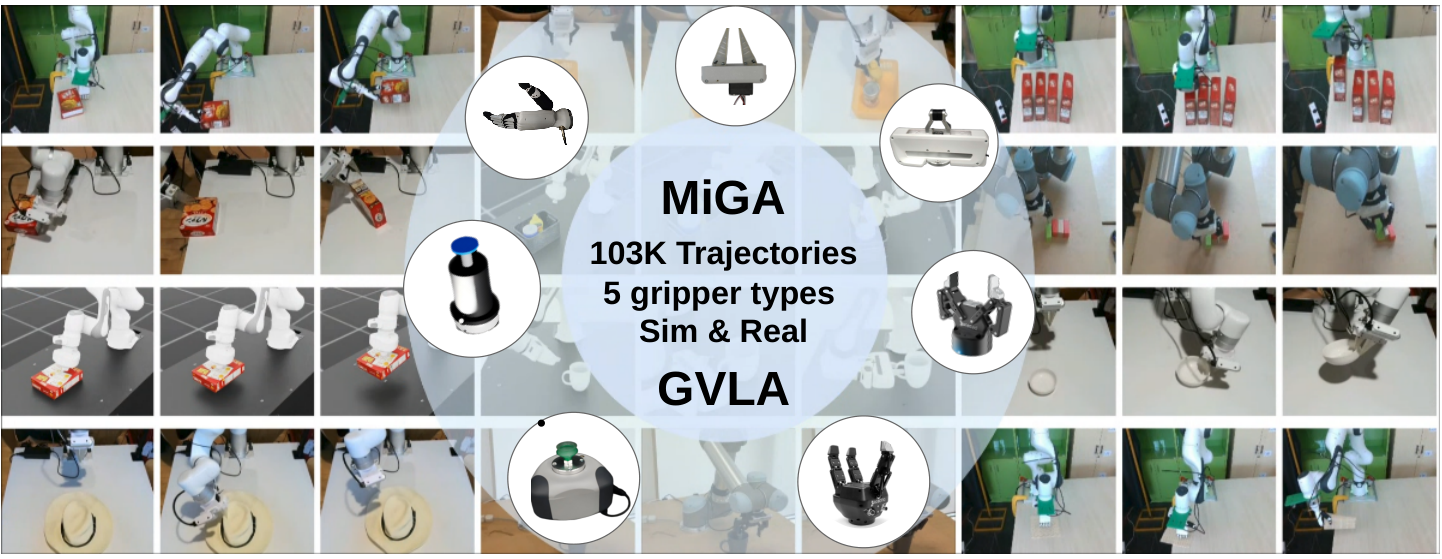
The project page says the paper is accepted at ECCV 2026. Their August 25 arXiv paper ships two pieces: MiGA, a dataset of 103,000 demonstrations across five gripper types and five robots, and GVLA, a fine-tune that tokens the gripper and routes adapters by type. On their simulation suite, GVLA on a π0.5 backbone averages 66.00% success versus 58.38% for vanilla π0.5 — the 7.62 point gap they quote. Project page: airvlab.github.io/G-VLA.
Why the same task is not the same motion
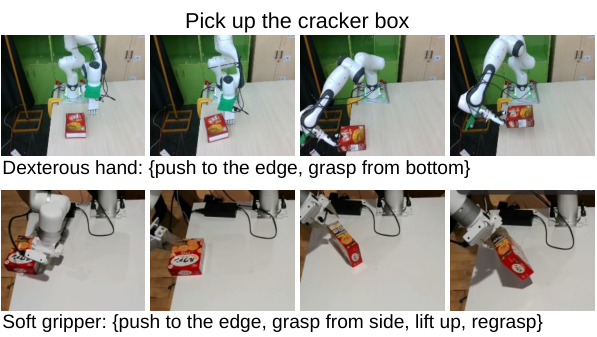
Their running example is a thin, flat box. A suction cup comes from above. A parallel jaw often has to slide the box to the table edge and grab the side. Datasets like Open X-Embodiment, DROID, and Bridge V2, they note, are almost all parallel jaws.
MiGA’s five types: Franka Panda and Robotiq 2F-85 jaws; Robotiq 3-Finger; an in-house soft two-finger; Cobot Pump and UR10 suction; Inspire five-finger hand. Sim is Isaac Lab on Franka and UR10. Real collection uses xArm7, Franka, and UR5, with wrist and third-person RGB-D. 36 tasks, each shown on at least three grippers, for 132 gripper-strategy pairs with language. About 5% of the set is failures.
How GVLA conditions the policy
They freeze a VLA backbone (they like π0.5) and add:
- Three-level soft prompts: robot platform, gripper type, gripper instance
- Dual mixture-of-adapters at the last action-expert layer, gated by those tokens
- Extra losses for gripper classification and adapter load-balance
MLP, VQ-VAE, and language-prompt embeddings of “which gripper” do not cluster by type on their heatmaps. Their tokenizer does.
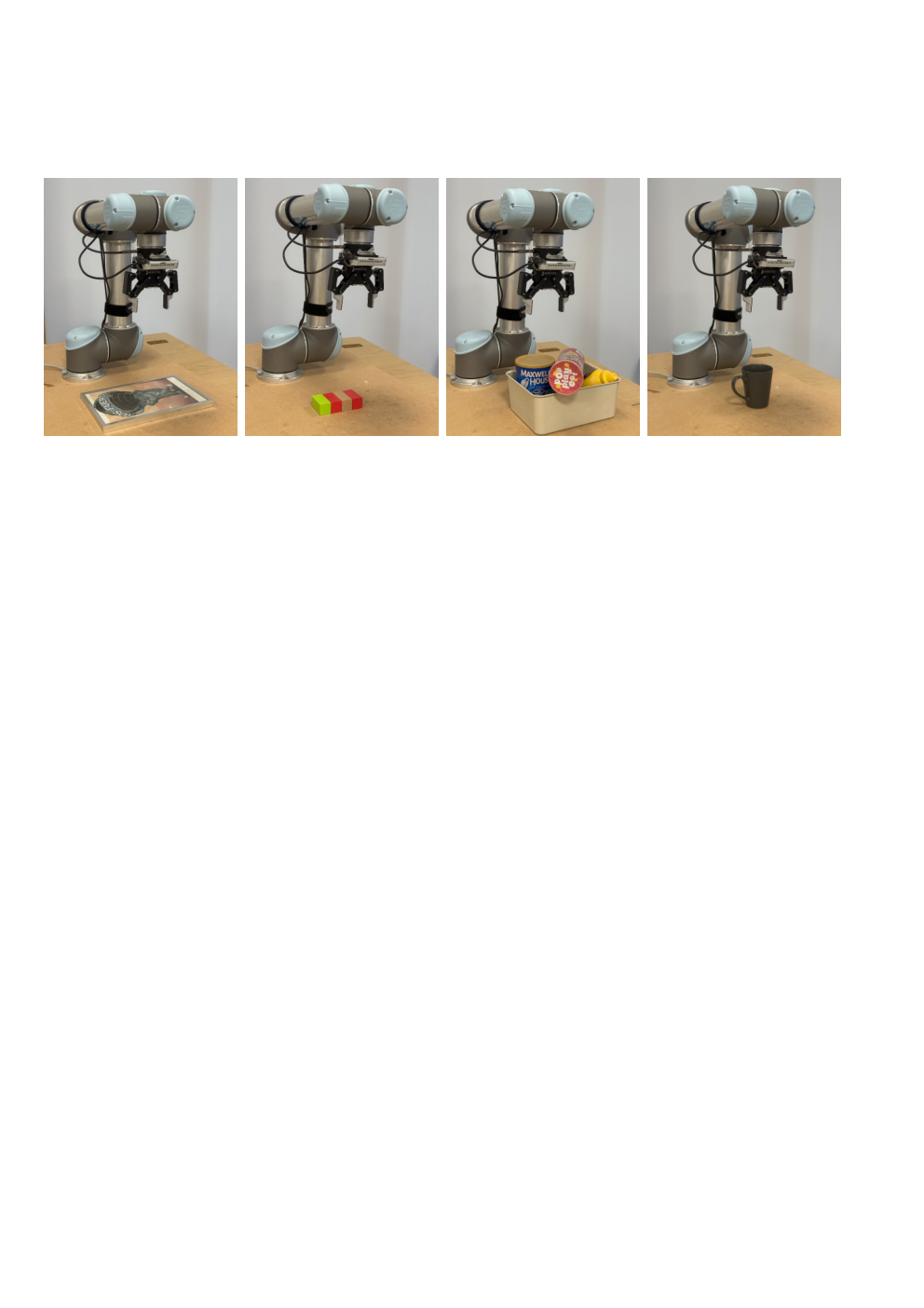
Category averages for GVLA (π0.5): flat 53%, stacked 76%, constrained 62.5%, semantic 72.5%. GraspVLA, trained on huge synthetic downward grasps, sits at 7.88% average on this mix. On a real UR5 plus Robotiq 2F-85, they fine-tune 10 demos and 20k steps on unseen tasks and report beating π0.5 across those tasks. Failures they show: type-correct but poorly aligned grasps, physical gripper limits, and kinematic dead-ends.
A Human’s Take
Telling the policy which gripper is on the wrist should have been table stakes. 103k demos that actually change strategy with the hardware is the useful part. I will believe the 7.62 points in other people’s cells when someone else trains on MiGA. Until then, the lesson I would steal is simple: stop averaging suction and fingers into one “grasp” token.