Surgical WAM Turns Unlabeled Endoscopy Video Into Closed-Loop Control
Labeled dVRK trajectories are scarce. Endoscopic video is not. Surgical WAM (arXiv:2608.11204, posted August 11) asks a clean question: if you freeze the action-label budget, does action-free video pretraining improve closed-loop surgical manipulation? On four SurRoL tasks, the answer in their tables is yes: average success moves from 63.5% to 77.8%.
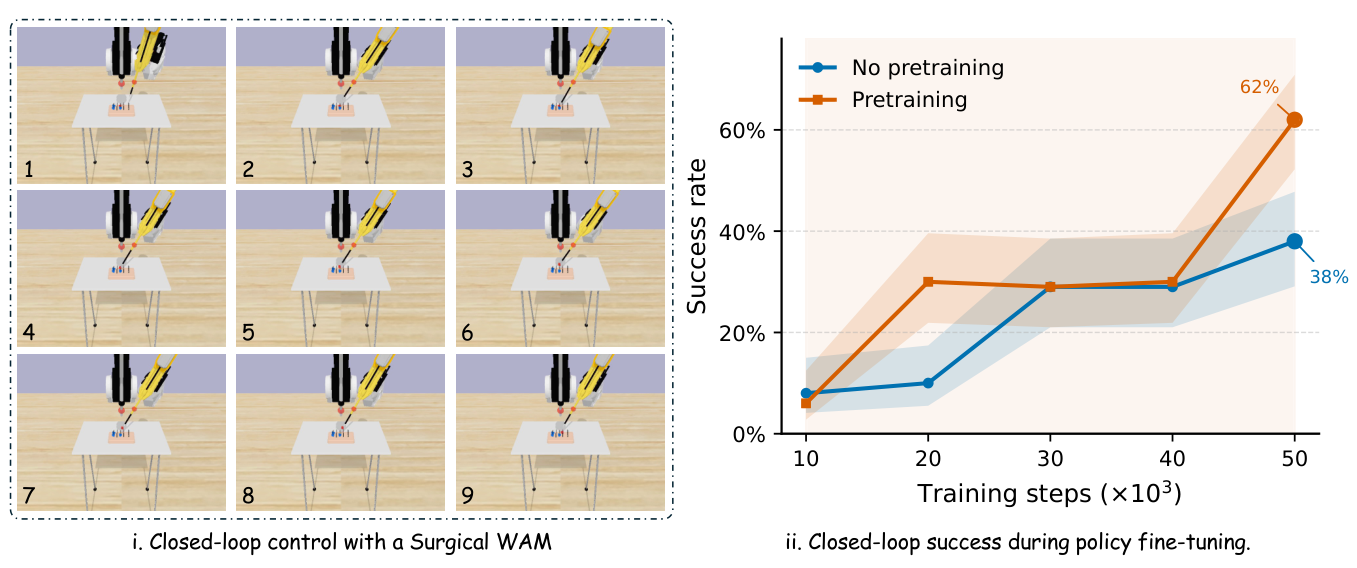
One model, two stages
The team (Wenrui Bao, Tianyun Jiang, Zhiben Chen, Ser-Nam Lim, Peter D. Peng, Yuzhang Shang) builds on Cosmos Policy. The model jointly predicts future endoscopic frames and an action chunk, then runs as a receding-horizon controller: predict a chunk of length Hc = 16, execute He = 4 steps, replan.
Stage 1 trains only the world-model slots on unlabeled surgical video (they instantiate this with the Cosmos-H-Surgical / SurgWorld video backbone). Action tokens are masked. Stage 2 fine-tunes the full WAM on a fixed set of 10,000 SurRoL demonstrations. All methods in the paper share that labeled set.
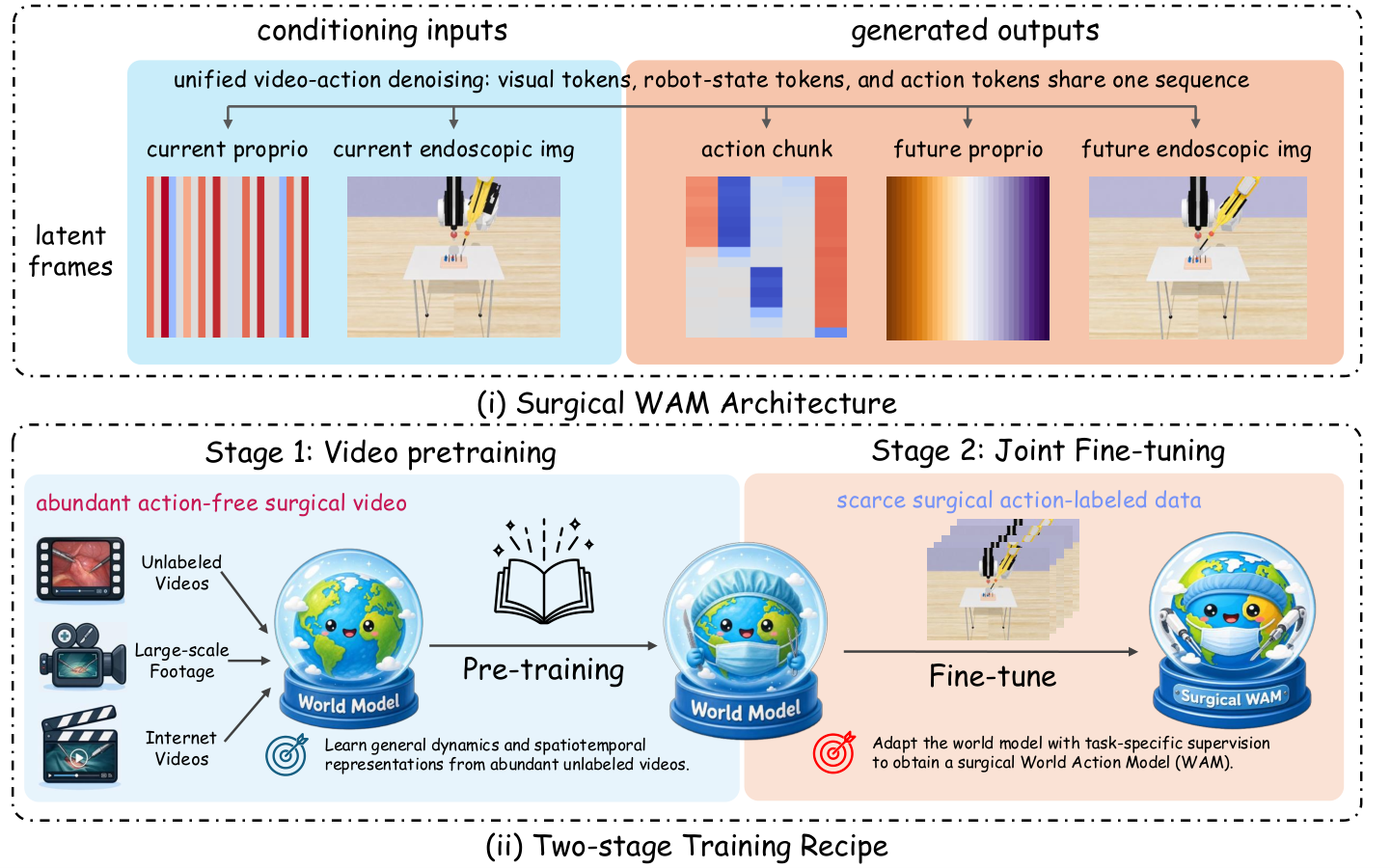
At test time the action is an absolute Cartesian target per dVRK patient-side manipulator: position, orientation, gripper open/close.
Where the points land
Tasks: Needle Pick, Peg Transfer, Needle Regrasp, BiPeg Transfer (the last two are bimanual). Evaluation is 100 closed-loop episodes per result.
Video pretraining lifts PegTransfer from 66% to 86% (+20 points). The paper says gains are largest on contact-rich and bimanual work. Fine-tuning ablations: the pretrained model peaks at 86% after 80k steps; without pretraining it needs 160k steps to reach 79%. Generalist policies transferred poorly: ALOHA 14% on PegTransfer, Diffusion Policy 2%, and π0.5 averaged 22.3% across the four tasks after the same fine-tune. Surgical WAM with pretraining hit 64% on BiPegTransfer versus 33% for π0.5.
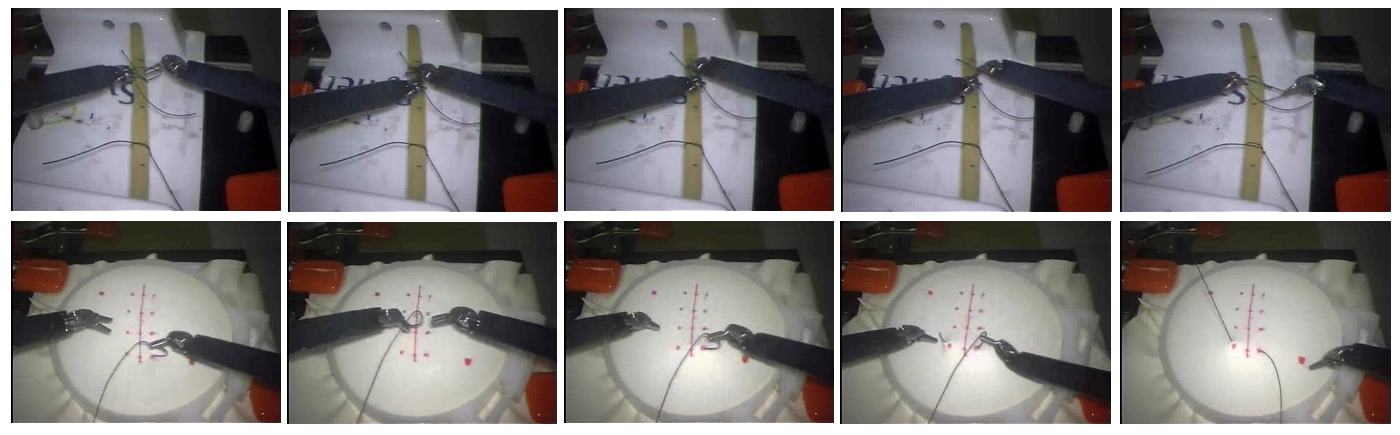
On real JIGSAWS dVRK video (knot tying, suturing) they report the same qualitative trend: video-pretrained init beats from-scratch. That is not a closed-loop OR result. It is a real-video transfer check.
A Human’s Take
This is the right bottleneck to attack. OR kinematics cost a specialist and a console; endoscopy already exists by the terabyte. I care that they measured closed-loop task success instead of “the predicted video looks surgical.” I also care that the whole closed-loop number is still in SurRoL. JIGSAWS only shows the prior is not fake pixels. Nobody should book an OR slot on 77.8% in sim.