Astribot’s SmoothRL Fine-Tunes a VLA While the Robot Is Still Moving
Big robot policies spit out a chunk of future actions, then take tens to hundreds of milliseconds to think about the next one. If you wait, a throw dies mid-swing. If you keep moving, the chunk you trained on is not the chunk the arm ran. Astribot’s SmoothRL paper, posted 30 August, is the attempt to do online RL inside that overlap.
The teaser figure is the part I care about. On a real throwing rollout, RMS acceleration and jerk at the right end-effector drop 52% and 47% versus the base policy.
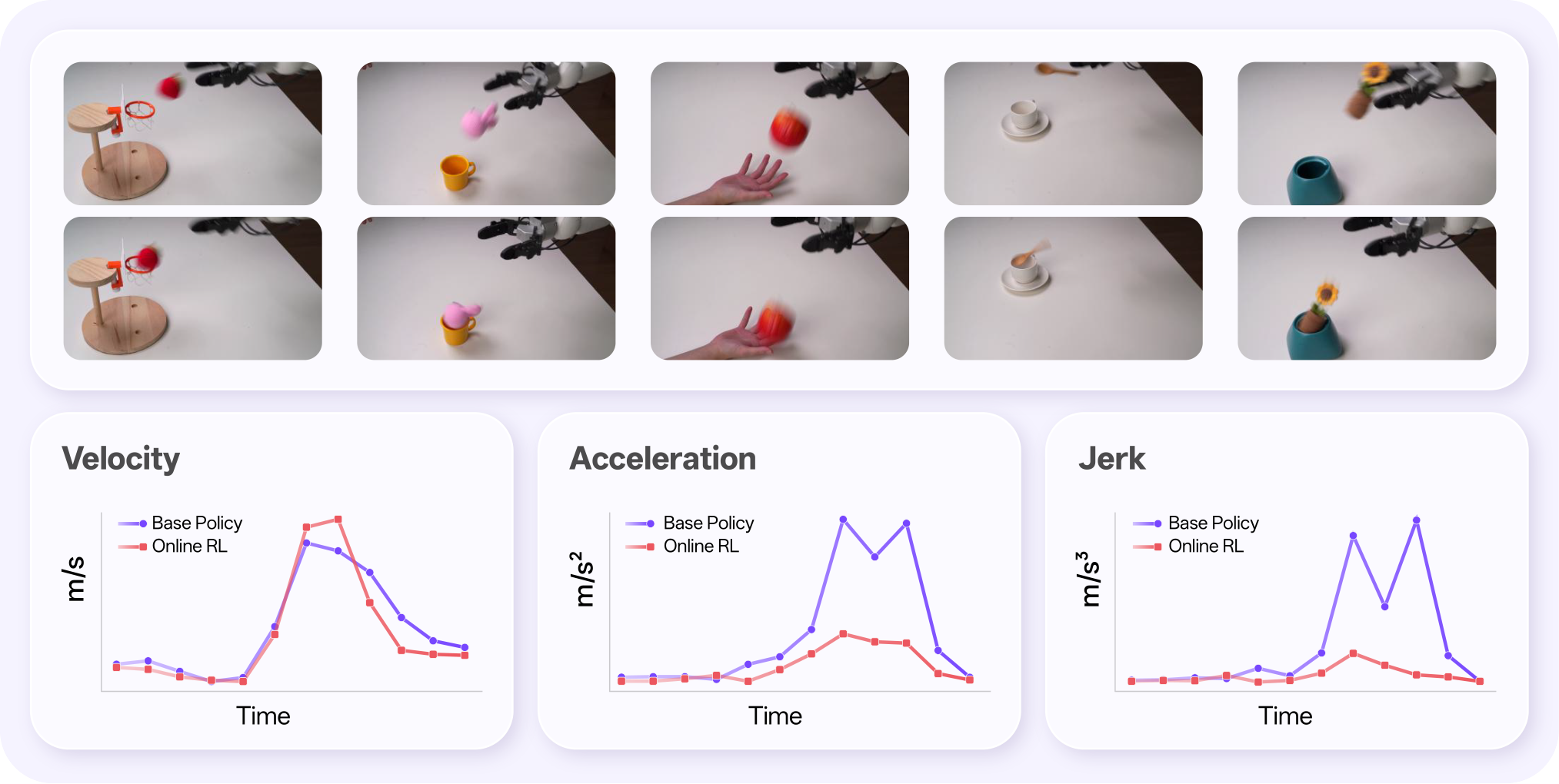
Only the frames that hit the motors
Each generated chunk is split by frame index:
- Committed: already issued by the last inference cycle
- Execution: the new frames the robot actually runs
- Discarded: superseded before they ever leave the buffer
Value gradients go only through the execution region. The critic still sees the committed prefix, because the in-flight chunk is part of the state. Training rollouts use the same asynchronous loop as deployment, so the replay buffer is not a sync-trained lie.
The implementation freezes a task-tuned π0.5 and hangs a TD3-style residual actor on an RL token, following the RLT skeleton. NetEase Intelligent, writing 4 September, says the S1 runs actions at 30 Hz and requests inference at 5 Hz (a new chunk every 200 ms). The base policy predicts 32 frames; under a fixed latency budget, committed plus execution cover 12 frames, 6 of them in the execution region.
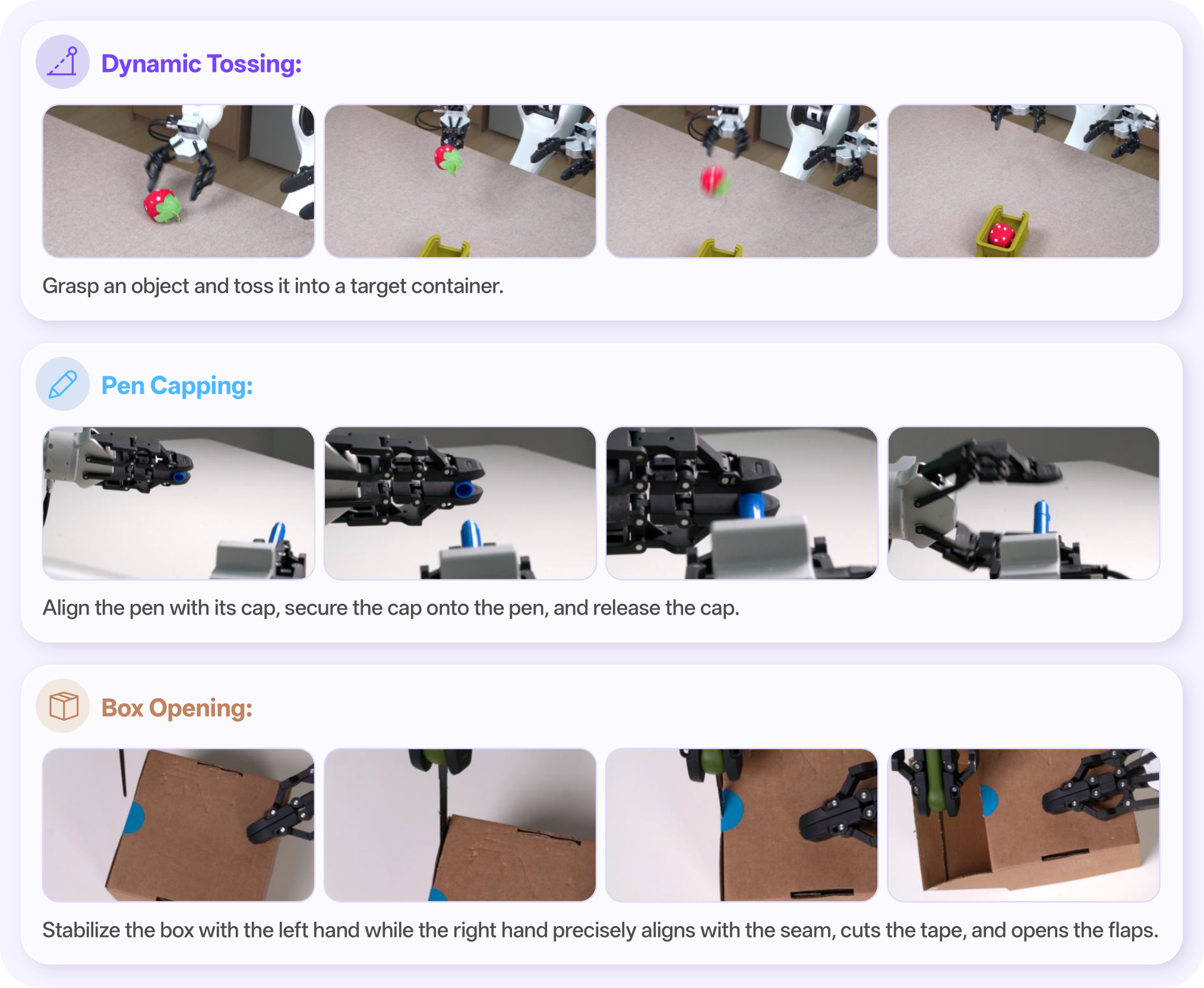
Three tasks, three systematic bugs
NetEase, citing the paper’s hardware results on the cable-driven Astribot S1:
- Dynamic throwing: 39% → 94% over 250 rollout episodes
- Pen capping: 8% → 83%, with relative pose error held around 5 mm
- Parcel opening: 30% → 90%, sliding a 1 mm blade into a 2–3 mm lid seam
The write-up says the failures were systematic: release speed on the throw, a left bias on the blade, capping motions that looked too alike. Online RL was there to push those biases back using what the robot actually did.
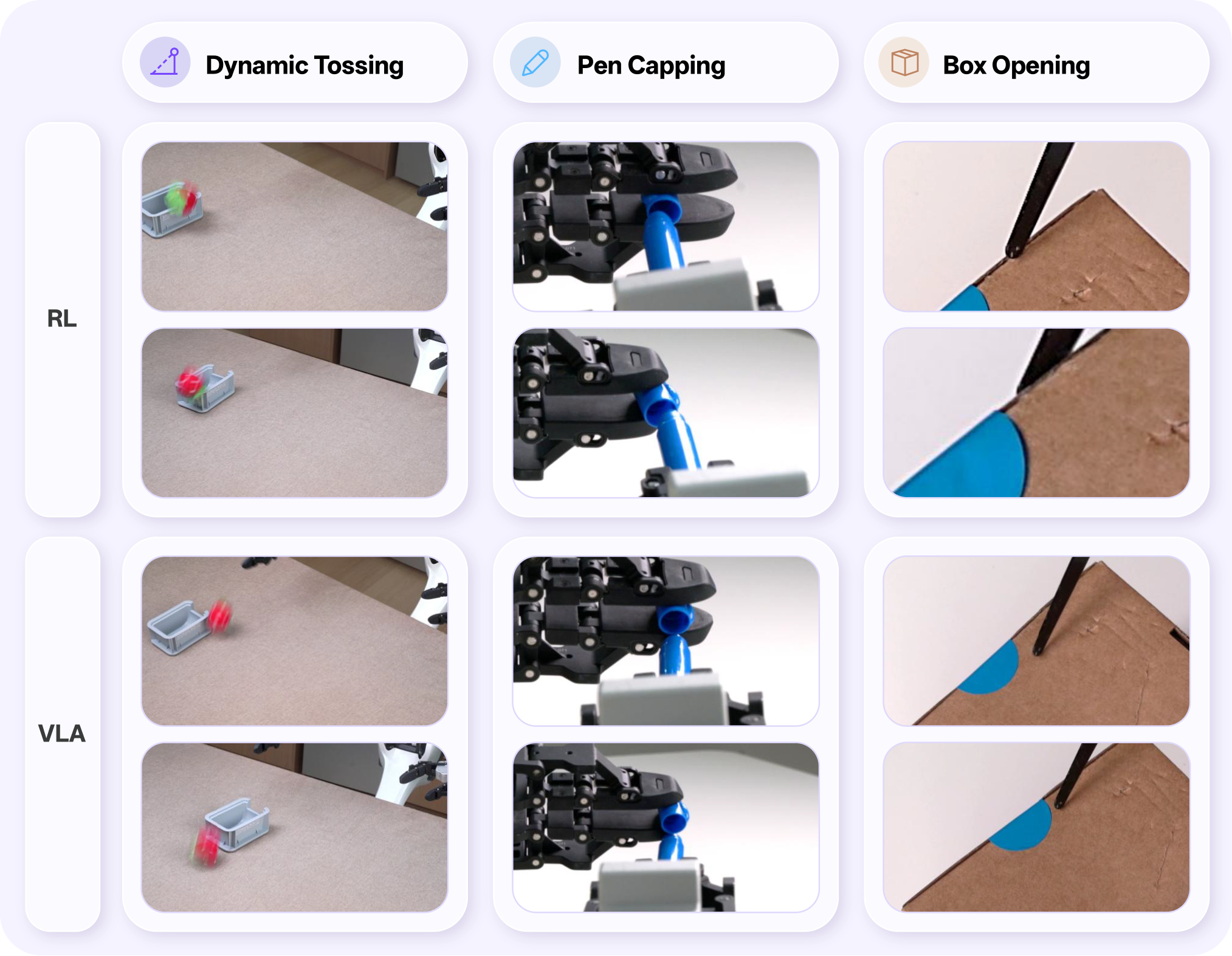
A failure grid in the paper puts the residual policy next to the frozen VLA: the VLA misses the bin, leaves the cap cocked, and plants the blade off the seam. The residual hits the bin, seats the cap, and tracks the tape line.
Human interventions land in the same raw action space, so a demonstrated chunk is a behavior-cloning target and a critic transition without latent inversion. Absolute VR takeover and residual stick offsets are both supported.
The company page for the report is astribot.com/research/SmoothRL.
A Human’s Take
If your VLA is slow enough to need async chunks, training it as if the whole chunk ran is a bookkeeping error. SmoothRL’s move is petty in a good way: mark the frames, throw away the rest of the gradient. I want to see the 250 throw episodes without a human hovering on the switch. Until then, the 52% jerk cut is the number I will repeat, because you can hear that in a video.