CMU’s Bridge Is an 88 cm Open-Source Humanoid Co-Designed With Its Controller
Most small humanoids get a body first and a walking policy later. Jianren Wang, Abhinav Gupta, Deepak Pathak, and collaborators at Carnegie Mellon, Huazhong University of Science and Technology, and JoyIn AI flip that order. Their paper, posted 3 September on arXiv, treats joint layout and control as one loop, then ships the result as Bridge, an open-source platform they say stands 88 cm tall.
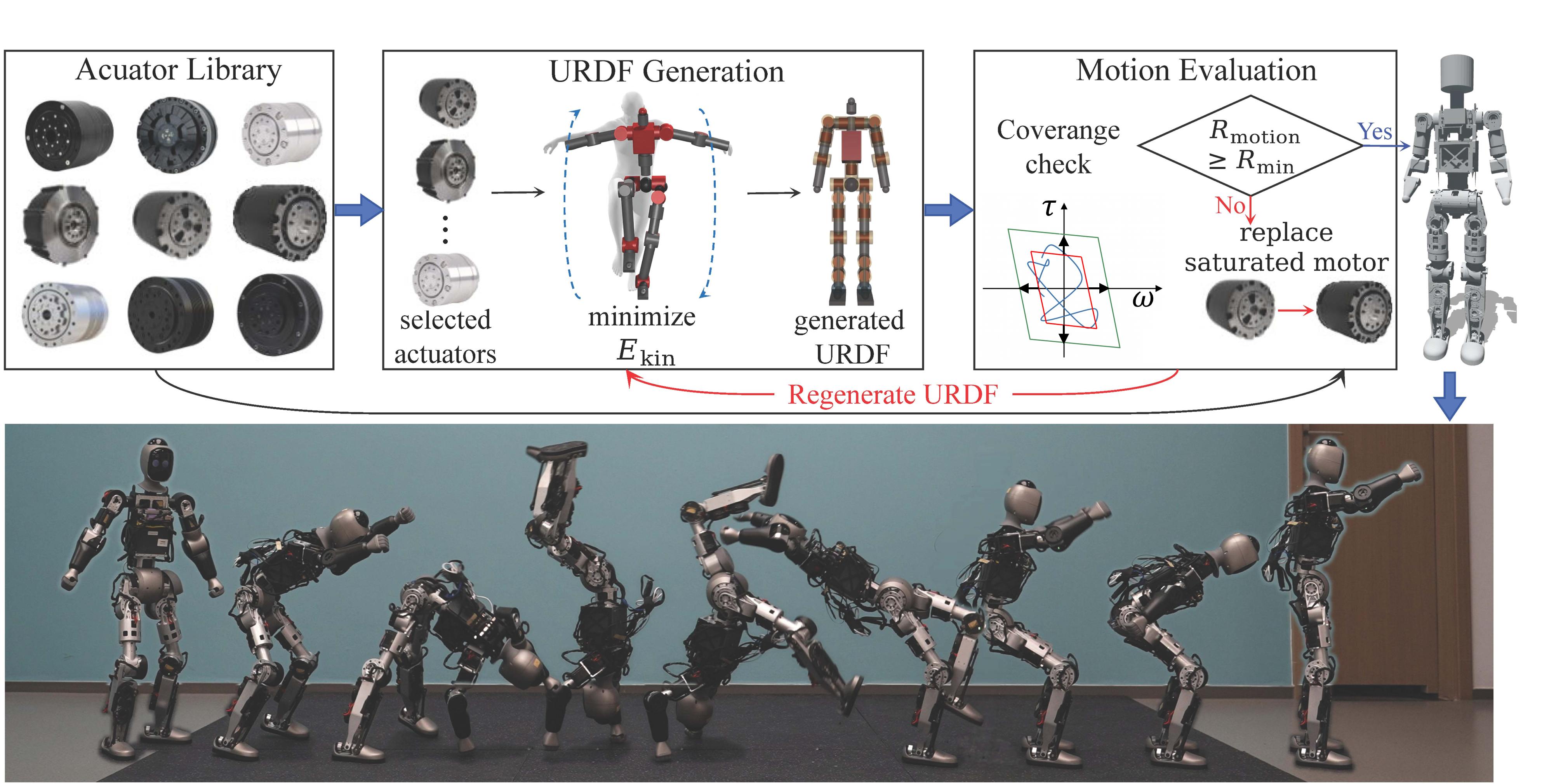
The teaser figure in the paper lists 13 kg. A comparison table in the same PDF lists 12.5 kg, 21 active degrees of freedom, 6 TFLOPS of onboard compute, open code, open design, and a $1,500 price. I am keeping both mass numbers because the authors printed both.
Design the body for the motion
The team starts from an SMPL human model, then compresses the waist until the robot stays under 90 cm with room for a battery. Kinematic screening keeps a roll-plus-yaw waist; closed-loop tracking then picks a one-DoF yaw waist as the better dynamic match.
Actuators are not an afterthought. The loop starts with the smallest motor that fits, trains a tracker, and only upgrades a joint when torque or speed saturates and relaxing the limit actually saves the motion. The selected stack uses 10 N·m-class motors in the arms, 55 N·m-class motors at hip pitch and knee, and 25 N·m-class motors elsewhere, including the parallel ankles.
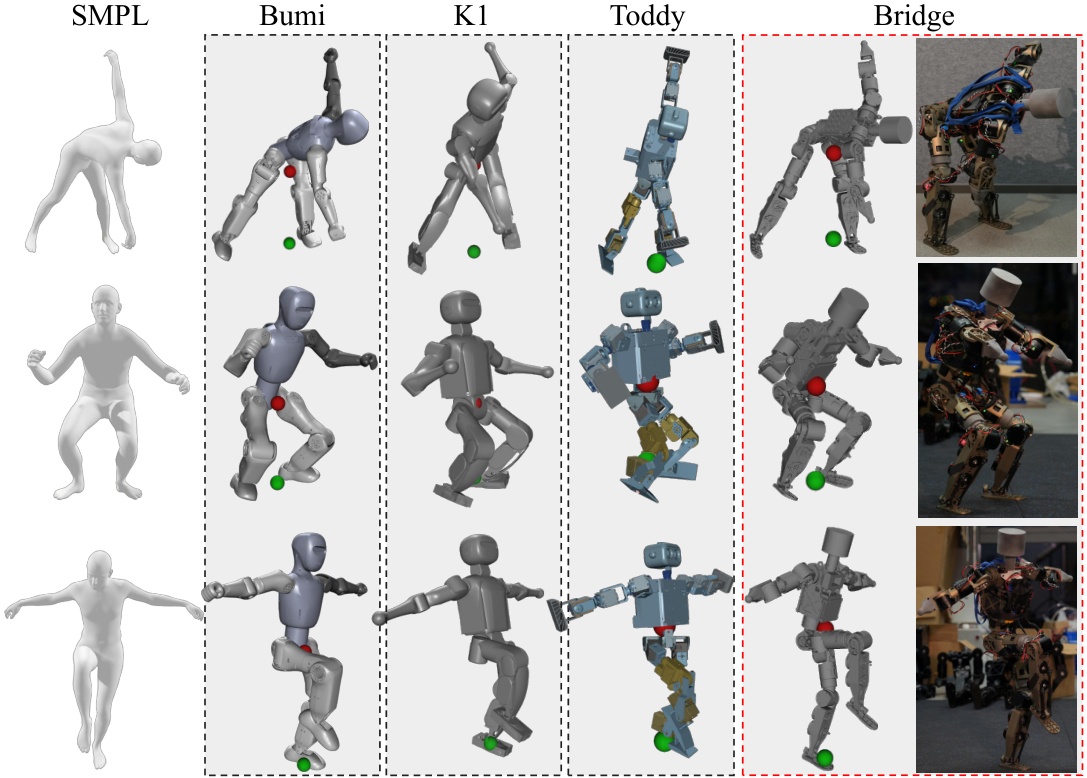
They score a morphology with a human-likeness metric that splits kinematic retargeting error and dynamic tracking error 50/50. On that score, Bridge beats Bumi, Booster K1, and ToddlerBot. Body-part scale versus SMPL is closest on Bridge (1.021 mean) versus ToddlerBot 1.171, K1 1.344, and Bumi 1.376.
What it does on the floor
In MuJoCo, SONIC tracking policies on a merged LaFAN1 / bones_seed set give Bridge a 94.83% success rate and the lowest joint, velocity, root, and keypoint errors of the four platforms. Split by category, the paper reports 95.00% on balance, 94.50% on highly dynamic motion, and 94.99% on daily motion. The biggest gap is the dynamic set, 4.70 points over K1.
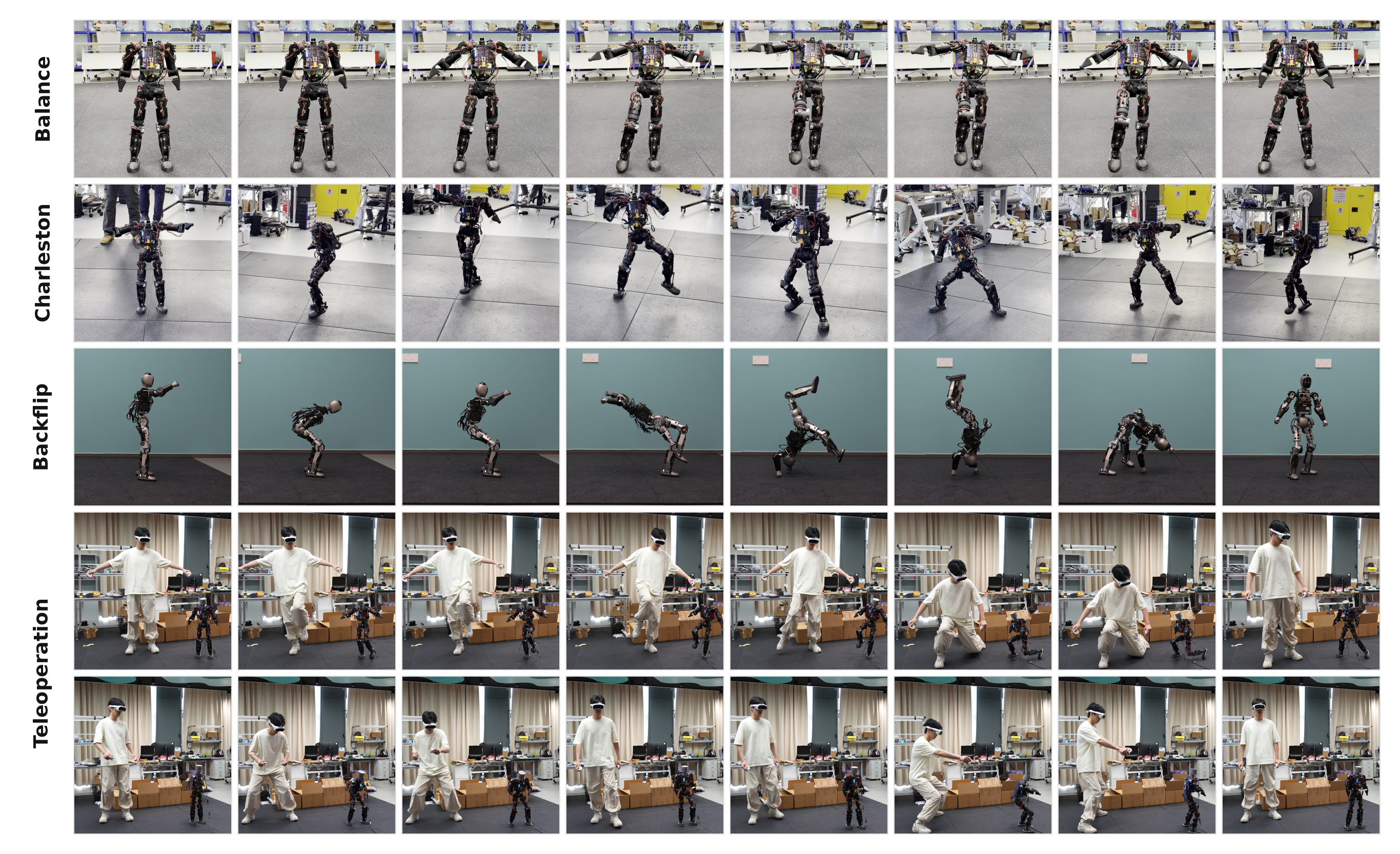
Real-robot stills show single-leg balance, a Charleston, a backflip, and a VR operator driving the small body around boxes. A subjective comparison figure in the paper puts Bridge next to Bumi, K1, and ToddlerBot on toe-touch, single-leg stand, and a low turn.
Videos and files sit on the project site.
The authors flag two limits: rotary motors only, and a small workspace. Tendon routing and a larger body are future work.
A Human’s Take
I like a kit that costs less than a used K1 and comes with the policy that made the joints worth stacking. The useful claim is not “we open-sourced a humanoid.” It is that they threw out waist pitch because the tracker said so, then put the expensive motors only where saturation showed up. If the CAD and the SONIC checkpoint actually land, this is how you get more labs doing backflips instead of another 3D-printed torso with a borrowed walk.