A One-Line ROS 2 Hook Can Fake What a Robot Is Doing
A Franka arm can be hijacked while its operator’s RViz still shows a clean pick-and-place. Leming Shen, Shikai Geng, Yuanqing Zheng, and Chris Xiaoxuan Lu (UCL and The Hong Kong Polytechnic University) posted the attack 8 September on arXiv: Seeing is Not Believing.
The trick is not breaking encryption. It is intercepting the message before Secure ROS 2 ever sees it.
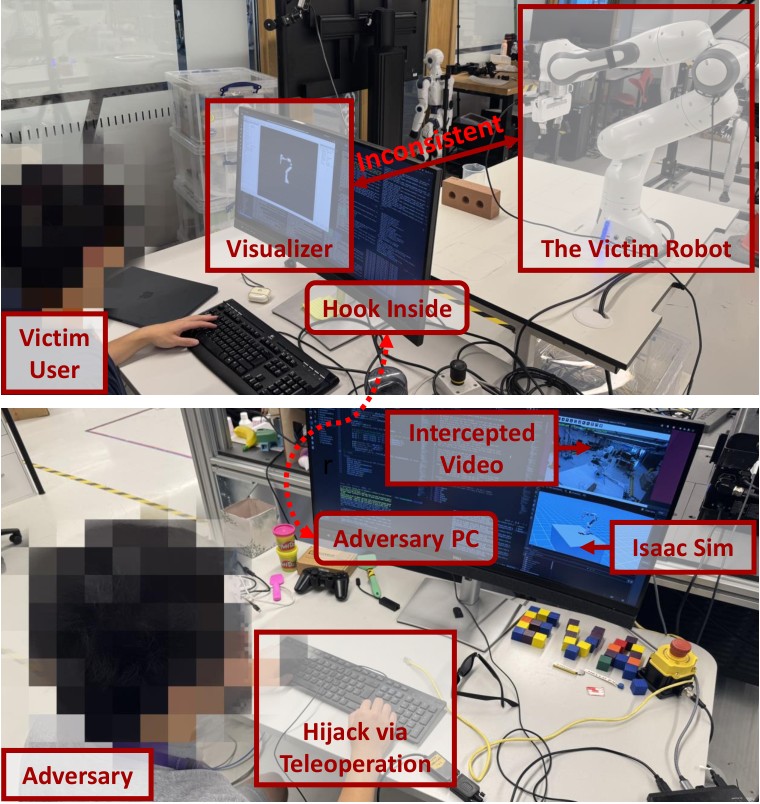
The hole
Linux lets a process preload a shared library with LD_PRELOAD. The authors export a fake rcl_publish. When the robot app publishes joint states or camera frames, the hook sees the payload first, rewrites it, then calls the real function. Official ROS 2 binaries stay untouched. No root. No stolen SROS 2 keys.
SROS 2 still authenticates and encrypts whatever leaves rcl_publish. The verifier gets a signed, encrypted lie.
They crawled 4,429 ROS-related Docker images. Verified namespaces take most of the 74.7 million pulls, but about 4,400 third-party images still account for 7.6 million pulls (10.2%). That is the distribution path they worry about: a “helpful” container that silently drops Hook.so.
What they measured
Hardware: Franka Emika arm, ROS 2 Humble, SROS 2 on. Attacker PC runs Isaac Sim as a digital twin.
- 100/100 hijack-and-spoof successes, with and without SROS 2.
- Injected telemetry delay stays under 3 ms; drop rate 0%.
- Four detectors: velocity bounds (98% bypass), position–velocity consistency (100%), cross-joint correlation (95%), autoregressive temporal model (87%).
The spoof is not Gaussian noise on each joint. They perturb the simulated trajectory with vibration, drift, and stick-slip, couple joints through the mass matrix, then derive position, velocity, and torque from that one motion so the channels stay physically consistent.
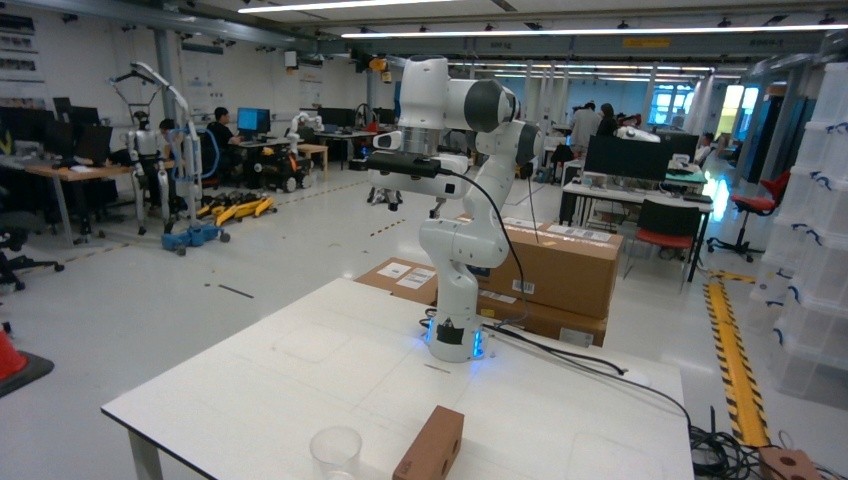
Camera spoofing in the paper is weaker: they forge a final-state image with a VLM, not a live multi-camera stream. The authors say live multi-view synthesis at warehouse scale is not practical for either side.
They disclosed to the ROS 2 team. The paper says the PMC acknowledged and discussed it. Their suggested fix is to sign payloads at the sensor, with a monotonic counter, so a user-space hook cannot mint them.
A Human’s Take
Encrypted telemetry that does not match the metal is a nasty class of bug. If your safety case is “the dashboard says it did the task,” this paper is the counterexample. Sign at the encoder, or stop treating RViz as a witness.